Mandala unfolds like a ritual. Its music does not rush toward melodies or familiar structures but instead builds its identity through pulse, repetition, and movement. What begins as a sonic landscape of drums and flutes gradually reveals itself as a carefully crafted work of remarkable depth and intensity.
The album “Mandala” brings together an impressive cast of musicians: Yosuke Yura, Kaoru Abe, Rie Hirata, Miku Shibata, and Atsushi Doi, with Estonian vocalist Liisi Koikson performing lyrics written by Maian Karmas. The result is a fascinating cross-cultural collaboration that never feels forced or artificial. Instead, it allows each artistic voice to serve the larger musical vision.
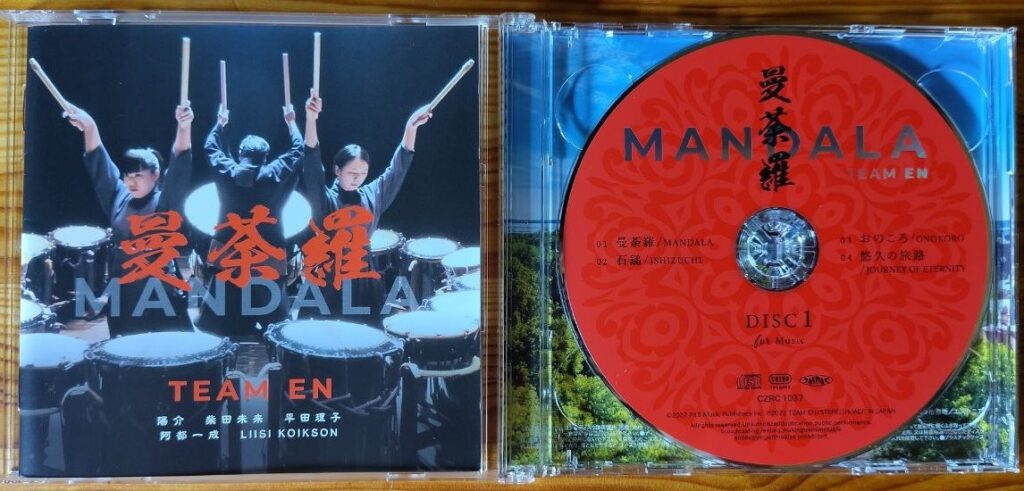
As Mandala is not available digitally, I had the opportunity to experience it through its physical CD edition, which was kindly gifted to me by Takashi Hiyama, the head of TEAM EN Inc. in Estonia. Listening to the album in my car quickly turned into a memorable experience and, since then, it has become part of my regular listening catalogue.
The opening composition is entirely instrumental and immediately establishes the album’s identity. Dominated by flutes and Taiko drums, it unfolds through constantly shifting rhythmic patterns that create an almost hypnotic effect. The powerful low-frequency drums resonate with extraordinary force, shaking the room while maintaining remarkable clarity and precision. The production quality is exceptional, allowing every rhythmic detail to emerge vividly. The combination of thunderous percussion, intricate rhythmic structures, and rich sonic textures creates a listening experience that is both visceral and intellectually engaging.
The remaining three pieces introduce vocals while preserving the album’s fundamental musical language. Liisi Koikson’s performs Maian Karmas’s Estonian texts. Although the lyrics are Estonian, the musical world surrounding them is entirely Japanese. Kiokson does not add any Estonianness to the music, she sings with the same articulations and expressions as the rest of the music. The result is that the voice becomes another instrumental layer within the broader sonic landscape.
In fact, the Japanese musical character is so dominant that listeners may initially assume the texts are being sung in Japanese. Even for an Estonian ear, it can take a moment to realize that the language is Estonian. The instrumental framework shapes every aspect of the listening experience, allowing the percussion and flute traditions to remain at the center while the voice flows naturally within them.
The physical presentation of the album deserves recognition as well. The booklet and visual design complement the music beautifully, reinforcing the atmosphere of contemplation, Estonian nature, and ritual suggested by the title Mandala. Together, the visual and musical elements create a cohesive artistic statement. The package consists of 2 CDs, one audio version and one video version of the performance.
Mandala is a brilliant album. Its music is captivating, its performances are outstanding, and its production quality is exemplary. More importantly, it offers something increasingly rare: a genuinely distinctive listening experience that transports the listener into a unique cultural and sonic landscape. Whether approached as a work of world music, contemporary traditional music, or simply as an exploration of rhythm and sound, Mandala is an album that leaves a lasting impression.
#EstonianMusic #JapaneseMusic #TaikoDrum #LiisiKiokson #Mandala #MusicAlbum #MandalaAlbum #CD #PhysicalRelease #MusicCD #JapaneseFlute #EstonianVocals