Frédéric Chopin (1 March 1810 – 17 October 1849) is universally celebrated as one of the most transformative figures in Romantic music. His virtuosic command of the piano, coupled with a lyrical sensibility that could make a single note sing, reshaped the instrument’s repertoire and inspired generations of composers and performers.
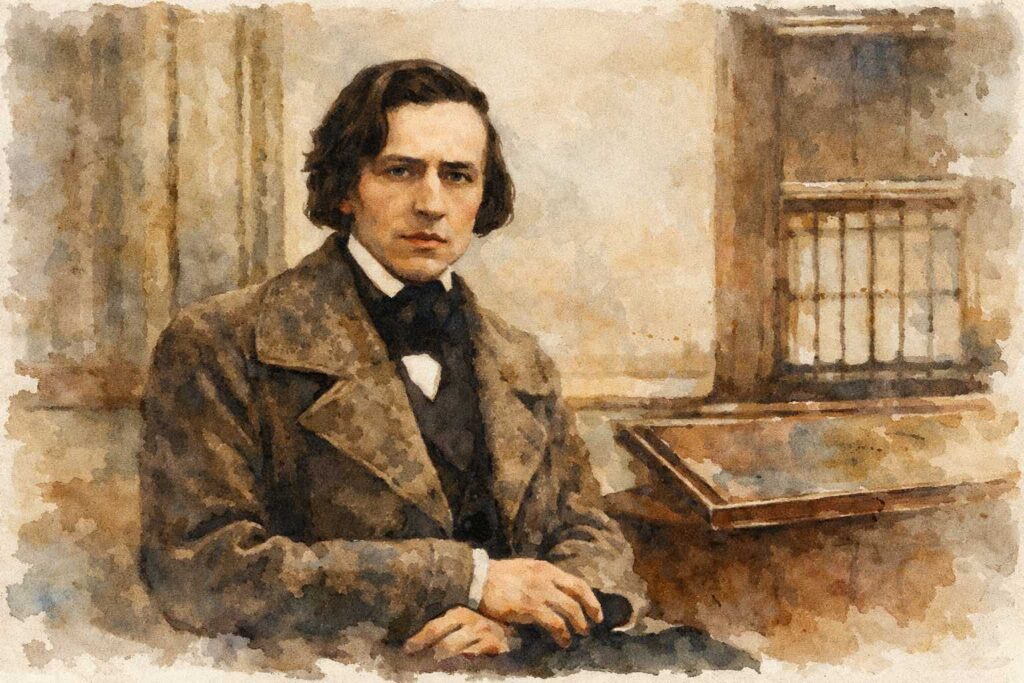
Frédéric François Chopin was born into a modest family in the Polish‑Prussian borderland of Żelazowa Wola, Chopin’s early exposure to folk melodies and church music planted the seeds of his lifelong fascination with melody and harmonic color. Though he spent only a few years in a formal conservatory, he developed a self‑taught style that blended Polish dance rhythms with advanced harmonic and rhythmic techniques. By the time he settled in Paris in 1831, Chopin had already begun to publish some of his most influential works, including the famous Nocturnes and Preludes. Over the next decade, he became a celebrated figure in Parisian society, performing for royalty and aristocracy while also refining his unique musical voice.
Early Life, Education, and First Musical Influences
Birth and Family Background
- Date of Birth: March 1, 1810
- Place: Żelazowa Wola (now in Poland), then part of the Duchy of Warsaw
- Parents: Nicolas Chopin (a French‑Polish businessman) and Justyna Krzyżanowska (a Polish housewife)
The Chopin family was not aristocratic, but they valued music. Nicolas, a shopkeeper, purchased a small piano for the children when they were young. This instrument became the first teacher in Frédéric’s life.
Early Musical Education
- Self‑Instruction and Early Lessons (1815–1825)
Frédéric Chopin began playing at the age of five, quickly mastering simple scales and folk tunes. By seven, he was composing brief pieces. His first formal lessons came from Tadeusz Głowiński, a local teacher who introduced him to classical forms. - The Warsaw Conservatory (1825–1827)
Chopin entered the Warsaw Conservatory at 15. The curriculum focused on counterpoint and traditional theory, but the political turbulence of the time (the 1830 November Uprising against Russian rule) disrupted his studies. Despite limited resources, he gained exposure to works by Bach, Mozart, and early Romantic composers. - Influence of Polish Folk Music and Nationalism
The Polonaise and Mazurka dance forms, popular among the Polish gentry and peasantry, became a defining part of Chopin’s melodic vocabulary. His sense of “national style” the incorporation of folk rhythms and modes, was shaped during his teenage years, influenced by the works of contemporaries like Józef Elsner and the broader Romantic trend of “musica folk”. - The 1827 Warsaw Concerts
In 1827, Frédéric Chopin gave a public performance that caught the attention of Klemens Janicki, a patron who would later help him secure a scholarship to study in Vienna. Though the scholarship was never realized (politics intervened), this period cemented his reputation as a promising young virtuoso.
Artistic Maturity
Relocation to Paris (1831)
The move to Paris marked the beginning of Chopin’s “Parisian phase.” In the vibrant cultural milieu of the city, he met influential artists such as:
- George Sand (Marie-Catherine Aurore Dupin), a writer who became his lover and patron.
- George Onslow, a composer who provided Chopin with a network in the French music scene.
- Ferdinand Hérold and Adolphe Adam, who helped Chopin secure court appointments.
Paris offered both artistic freedom and financial stability, allowing Chopin to compose without the constraints of court duties.
Key Works of His Mature Period
| Year | Work | Significance |
|---|---|---|
| 1833 | Nocturne in C‑sharp minor, Op. 27 No. 1 | Demonstrates lyrical lyricism and advanced harmonic progressions. |
| 1834 | Ballade No. 1 in G‑minor, Op. 23 | Integrates narrative structure and dramatic intensity. |
| 1839 | Etudes Op. 10 & 25 | Reforms piano technique, combining virtuosity with musicality. |
| 1844 | Piano Concerto No. 1 in E‑major, Op. 11 | Combines lyrical themes with a robust orchestral framework. |
| 1845 | Polonaise in A‑major, Op. 53 (Heroic) | Embodies Polish patriotism and technical brilliance. |
| 1847 | Nocturne in B‑flat major, Op. 62 No. 1 | Reflects mature harmonic language and poetic nuance. |
These works illustrate Chopin’s ability to fuse complex harmonic language with intimate expressiveness.
Importance in the Classical Music Canon
- Revolutionizing Piano Technique
Frédéric Chopin introduced unprecedented demands on the piano: rapid rubato, nuanced pedaling, and extended use of the sustain pedal. His Etudes are not merely technical studies but complete musical statements, influencing later virtuosos like Liszt and later Romantic composers. - Expansion of Harmonic Language
By employing chromaticism, modulations to remote keys, and ambiguous cadences, Chopin laid the groundwork for 19th‑century harmonic exploration. His harmonic daring prefigured the works of Debussy, Ravel, and the impressionists. - Nationalism and Identity
He demonstrated how music could convey national identity without explicit political statements, thereby inspiring nationalist movements across Europe. - Emphasis on Musical Narrative
Frédéric Chopin’s Ballades and Romances turned the piano into a medium capable of telling intricate, almost literary stories, a tradition continued by later composers such as Schumann and Brahms.
Greatest Works
1. Nocturnes
- They epitomize Chopin’s gift for lyrical melody, expressive rubato, and rich harmonic textures.
- Notable pieces: Op. 9 No. 2, Op. 25 No. 1, Op. 48 No. 1.
2. Etudes
- They combine technical challenges with deep musical substance.
- Notable pieces: Op. 10 No. 3 (“Revolutionary Etude”), Op. 25 No. 9 (“Butterfly Etude”).
3. Ballades
- They provide narrative arcs reminiscent of ballads, integrating poetic and dramatic elements.
- Notable pieces: Op. 23 No. 1, Op. 34 No. 2.
4. Polonaises
- They embody Polish dance rhythms with virtuosic flair.
- Notable pieces: Op. 53 (“Heroic”), Op. 40 No. 1 (“Funeral March”).
5. Preludes
- A set of 24 pieces, each exploring a unique key and mood, culminating in Prelude in D‑minor, Op. 28 No. 15.
Composition Style
| Element | Chopin’s Approach |
|---|---|
| Melody | Lyrical lines influenced by folk tunes; wide, singing intervals. |
| Harmony | Advanced chromaticism; use of whole‑tone scales, diminished seventh chords, and modulations to distant keys. |
| Rhythm | Fluid rubato; syncopated figures; dance‑based forms (Polonaise, Mazurka). |
| Texture | Rich, often contrapuntal yet transparent; interplay of bass and melody. |
| Pedal Use | Extensive use of sustain pedal for legato, blending harmonies; careful release to maintain clarity. |
| Form | Romantic lyricism over classical forms; often expanded or reinterpreted (e.g., Nocturne as a mini‑symphony). |
Influence on Others
- Franz Liszt: While Liszt emphasized virtuosic display, Chopin’s expressive depth influenced Liszt’s later “Romantic” works.
- Claude Debussy: Debussy’s impressionistic harmonies owe much to Chopin’s chromatic experimentation.
- Pyotr Ilyich Tchaikovsky: Tchaikovsky’s piano concerto’s lyrical themes echo Chopin’s melodic style.
- Modern Pianists: Virtuosos like Arthur Rubinstein, Vladimir Horowitz, and Martha Argerich continue to interpret Chopin’s works with reverence for his stylistic nuances.
Why Frédéric Chopin Is Important
- Pioneering Romanticism: Chopin’s fusion of technical mastery with profound expressivity epitomizes the Romantic ethos. Although he was not technically the first romantic composer, he was without a doubt one of the first who made romanticism what it is today.
- Transforming Piano Literature: He shifted the piano from a tool for accompaniment to a solo instrument capable of conveying complex narratives.
- Cultural Ambassador: His music preserved Polish cultural identity during political turmoil, making him a national icon.
- Innovative Harmonic Language: Chopin expanded the palette of tonal harmony, influencing Western music’s evolution into the 20th century.
- Universal Appeal: His works, characterized by emotional immediacy and technical clarity, resonate with audiences worldwide.
The Tale of Chopin’s Heart
When Frédéric Chopin died on October 17, 1849, in the Rue de Vaugirard in Paris, his physician, Dr. Jean-Louis‑Père de la Chapelle, performed the unusual act of removing the composer’s heart and preserving it in a silver box filled with a liquid preservative. In a letter to his beloved, the doctor wrote that the heart would be kept until Chopin’s body could be returned to his homeland. However, the political turmoil that followed his death delayed any such transfer. For almost a century, the heart remained in a private collection in Paris, its existence almost forgotten by the public. It was not until 1965 that the Polish State’s Institute of the Polish Academy of Sciences requested the heart’s return. After extensive diplomatic negotiations, the heart was finally repatriated and ceremoniously laid to rest in a small sarcophagus beneath the altar of the Church of the Passion of Our Lord in Warsaw, symbolically completing the composer’s unfinished wish to return his heart to his beloved Poland. The heart’s preservation in a jar—often misquoted as “a jar” rather than a silver box—has become a poignant symbol of Chopin’s enduring connection to his homeland and his lasting legacy in both Polish and global music history.
The Rediscovered Waltz of Frédéric Chopin
In an extraordinary 2024 find, the Morgan Library and Museum in New York revealed a previously unknown Chopin waltz—an A‑minor gem dated between 1830 and 1835 that marks the first authentic discovery of the composer in more than fifty years. While cataloging memorabilia, researcher Robinson McClellan stumbled upon the manuscript, and after a painstaking forensic analysis of the handwriting, paper, and ink, its authenticity was confirmed; renowned Chopin scholar Jeffrey Kallberg recounted the moment of revelation, “my jaw dropped.” The 48‑measure piece (about 80 seconds with repeats) opens with a dramatic triple forte that evokes the raw chill of Polish winters, a sentiment echoed by pianist Lang Lang who noted its “youthful vigor” and authentic early‑Romantic flavor. Premiered at Steinway Hall, Lang Lang’s rendition highlighted the work’s emotive depth despite its modest technical demands, earning praise from critics and audiences alike. Classic FM remarked that, while not the most complex of Chopin’s oeuvre, the waltz vividly captures the composer’s formative genius, and its publication is now highly anticipated by scholars and performers eager to explore this fresh chapter of Frédéric Chopin’s legacy.
Final Thoughts
Frédéric Chopin’s brief life (aged 39) belies the depth and breadth of his contributions. He carved a niche where the piano could sing, dance, and weep, all at once. His compositions are not merely technical exercises; they are living, breathing works that continue to move listeners and challenge performers. Whether you’re a seasoned pianist or a casual listener, exploring Chopin’s oeuvre offers a window into the soul of Romantic music.
Sources:
#FrédéricChopin #Piano #RomanticMusic #PolishMusic #MusicHistory #ClassicalMusic #Nocturne #Etude #Ballade #Polonaise #MusicInfluence #ChopinLegacy