Philip Glass (31 January 1937) stands as one of the most revolutionary composers of the late 20th and early 21st centuries. Defying easy categorization, he crafted an unmistakable musical language that reshaped what modern classical music could be. Glass’s work dissolves boundaries between genres, opera, symphony, film, popular music, and world traditions, to create deeply immersive soundscapes that are at once intellectual, emotional, and hypnotic.
Early Life, Education & First Musical Influences
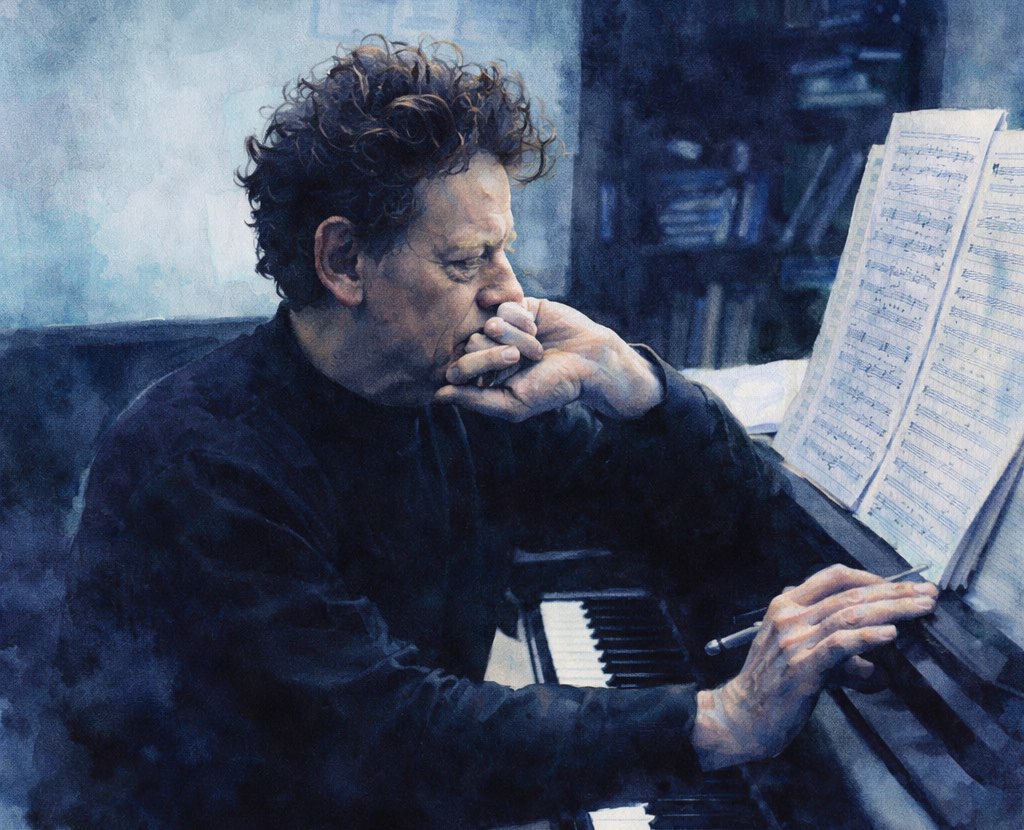
Philip Glass was born in Baltimore, Maryland. He grew up immersed in music, influenced by the eclectic records at his family’s store and by early studies in violin and flute beginning in childhood. Glass entered the University of Chicago at age 15, studying mathematics and philosophy, and graduated in 1956. He then studied composition at the Juilliard School of Music in New York, earning a master’s degree.
In the 1960s, Glass received a Fulbright Fellowship to study in Paris with the legendary teacher Nadia Boulanger, whose rigorous training in harmony and counterpoint honed his technical mastery. During this period he also worked with Indian sitar virtuoso Ravi Shankar, a meeting that would decisively influence his compositional approach, especially his use of cyclic rhythms and repetition drawn from non-Western music.
Artistic Maturity
After returning to New York in 1967, Glass formed the Philip Glass Ensemble, an amplified group of keyboards and winds that became the primary vehicle for his early works. His music of this period employed extended repetition of brief motifs in interlocking rhythmic patterns, generating an immersive, trance-like energy that challenged conventional Western forms.
By the mid-1970s, Glass’s mature voice emerged most dramatically in Einstein on the Beach (1976), an innovative opera created with artist Robert Wilson that broke from traditional narrative and musical form. Subsequent operas, including Satyagraha (1980) and Akhnaten (1983), deepened his exploration of minimalist structures blended with expressive harmonic and melodic elements.
Glass’s later output expanded into symphonies, concertos, chamber music, solo piano works, and a prolific series of film scores. His three symphonies inspired by David Bowie and Brian Eno’s Berlin albums illustrate his ability to intertwine contemporary cultural threads with classical tradition.
Importance & Greatest Works
Philip Glass’s importance lies not only in his extraordinary productivity, over 30 operas, more than a dozen symphonies, and numerous concertos, but also in his profound influence on the sound world of contemporary music. Few composers have so successfully reshaped the relationship between repetition, harmony, rhythm, and large-scale musical form while remaining accessible to a broad audience.
Among his most significant works are:
- Einstein on the Beach (1976) — A landmark opera that fundamentally redefined what opera could be, abandoning traditional narrative in favor of structure, process, and pure musical time.
- Satyagraha (1980) — A spiritual and rhythmic meditation on the early life of Mahatma Gandhi, marked by hypnotic repetition and moral gravity.
- Akhnaten (1983) — The final opera of the “Portrait Trilogy” and one of the most dramatic and visually striking works in contemporary music, combining ritual, history, and minimalism into a timeless theatrical experience.
- Glassworks (1982) — A pivotal work designed to introduce Glass’s musical language to a wider audience, balancing clarity, pulse, and lyrical directness.
- Koyaanisqatsi (1982), film score — A groundbreaking collaboration with filmmaker Godfrey Reggio that permanently altered the way minimalist music interacts with cinema.
- Violin Concerto No. 1 (1987) — One of Glass’s most celebrated concertos, merging minimalist techniques with Romantic expressiveness. Its emotional immediacy and long-arched melodic lines have made it a cornerstone of the contemporary violin repertoire.
Alongside these works stands a wide range of symphonies and concertos that expand Glass’s idiom into orchestral and solo forms, proving that minimalism can sustain large-scale architecture without losing intensity or depth.
Beyond the concert hall, Glass’s music has deeply intersected with popular culture. His influence can be traced through rock, ambient, and electronic music, and his sound world has shaped film and television scoring, from artists such as Brian Eno and David Bowie to countless contemporary composers working across media.
A Personal Encounter
My first encounter with Philip Glass came through his remarkable film score for The Hours. The music completely mesmerized me, its emotional clarity and quiet intensity lingered long after the film ended. As I explored his work more deeply, I discovered his violin concertos, and especially the First and Second Violin Concertos, which made me fall in love with his musical language.
But it was ultimately Akhnaten that elevated Philip Glass to an almost god-like stature for me, placing him among the greatest composers in human history. In that work, time, ritual, sound, and philosophy converge in a way that few composers have ever achieved. Maybe that’s because of my love for narrative music and mythology combined, but there’s no denying the importance of this piece in contemporary music repertoire.
Composition Style & Influence on Others
Glass is frequently associated with minimalism, though he preferred the term music with repetitive structures. His style uses sustained patterns, gradual transformation, and rhythmic momentum to forge an almost meditative sonic world. Especially in early ensemble works like Music in 12 Parts (1974), Glass layered simple musical cells into vast evolving tapestries.
Unlike traditional Western music’s focus on development and contrast, Glass’s pieces often create impact through accumulation and subtle transformation, inviting listeners into a state of heightened awareness. His influence ripples through contemporary classical music and across genres: ambient, post-rock, film scoring, and even popular electronic and soundtrack composers draw on his aesthetic.
Why Philip Glass Matters
Philip Glass matters because he expanded the language of modern music. He tore down barriers between composer and audience, high art and popular culture, tradition and innovation. By embracing non-Western rhythmic principles and blending them with deep classical training, he created a sound that feels both timeless and radically new. His music invites listeners into a process, not merely to be heard, but to be experienced.
Final Thoughts
Philip Glass has redefined how we think about repetition, rhythm, and the architecture of sound. His legacy is measured not only by his works’ presence in concert halls and opera houses but by how deeply they’ve permeated our cultural landscape, from film and theater to the playlists of listeners worldwide. His music reminds us that simplicity can be a gateway to profound emotional and intellectual depth.
Sources:
- Philip Glass biography — Encyclopaedia Britannica
- Official Philip Glass biography
- National Endowment for the Arts profile
- Philip Glass overview (opera data)
- History Of Creativity
- Classical‑Music
#PhilipGlass #Minimalism #ContemporaryClassical #Opera #FilmScore #ModernMusic #GlassEnsemble #MusicInnovation