In most orchestral performances, the snare drummer is a figure of rhythmic stability, tucked away in the back row. But in Patrice Leconte’s 1992 short film, Le Batteur du Boléro, the drummer becomes the protagonist of a psychological thriller.
While Maurice Ravel’s Boléro is often celebrated as a triumph of orchestration, Leconte’s film, and the internal monologue of its weary percussionist, reveals the truth: it is a seventeen-minute endurance test that borders on musical “cruelty.”
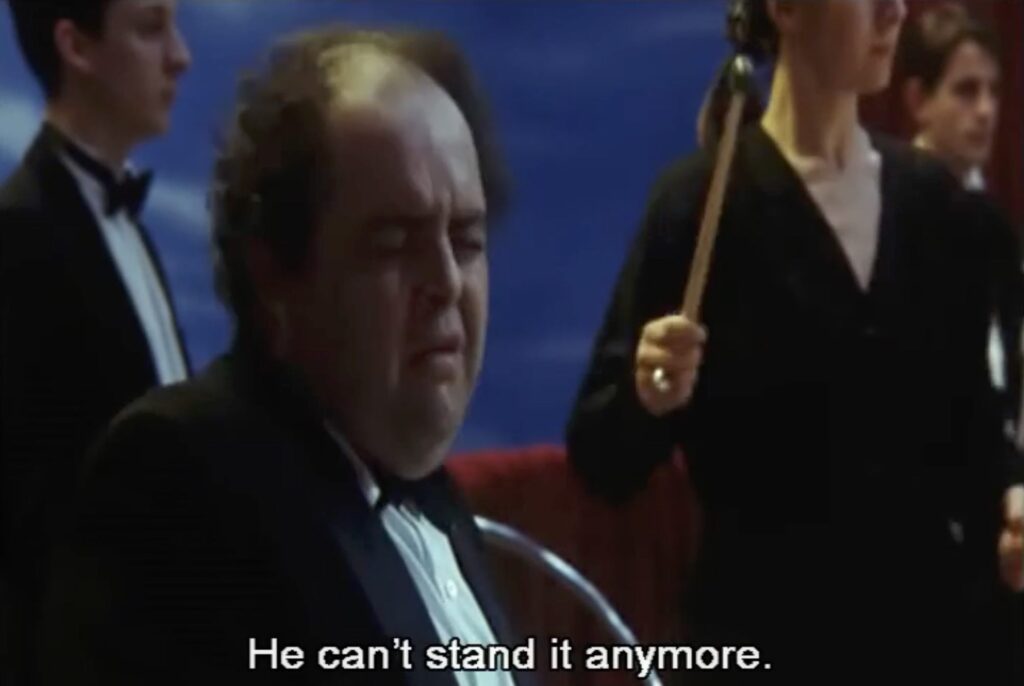
The Face of Rhythmic Captivity
The film is deceptively simple. There are no sweeping shots of the brass section or dramatic close-ups of the conductor. Instead, the camera remains locked on the face of Jacques Villeret, who plays the titular drummer.
As the famous two-bar rhythm begins, we see a man trying to maintain professional dignity while trapped in a loop. Through subtitled “director’s thoughts” and Villeret’s masterful micro-expressions, we witness the stages of a musical breakdown:
- Minute 2: Stoic concentration.
- Minute 8: Terminal boredom and a wandering mind.
- Minute 12: Genuine physical agony (the “lower back scream”).
- Minute 15: Pure, unadulterated resentment toward the flute player.
A Masterpiece “Without Music”
Ravel famously described Boléro as a “masterpiece… without any music in it.” He wasn’t being humble; he was being literal. The piece is a giant machine. It consists of:
- A single rhythm played 169 times.
- Two themes that never develop or change.
- A steady crescendo that slowly ratchets up the blood pressure of everyone on stage.
Leconte’s film captures the irony of this structure. While the audience experiences a “hypnotic trance,” the drummer is experiencing a manual labor shift. He is the only person in the room who cannot afford to feel the music; if he loses his place by a single beat, the entire seventeen-minute “machine” collapses.
The E Major “Breakout”
The tension in both the music and the film builds toward a breaking point. For nearly the entire duration, the piece is anchored stubbornly in C major. It is a harmonic prison.
In the final moments, Ravel finally allows a modulation to E major. In the film, this isn’t just a musical shift, it’s a jailbreak. The camera finally captures the explosion of sound as the drummer is allowed to break his repetitive loop and join the rest of the orchestra in a dissonant, crashing finale.
“It’s the only piece of music where the performer is praying for it to end while the audience is praying for it to go on forever.”
The Legacy of the “Madman”
When Boléro premiered in 1928, a woman famously shouted that Ravel was a madman. Ravel agreed. Le Batteur du Boléro proves why. It strips away the “romance” of the concert hall to show the grit, the sweat, and the hilarious absurdity of a man forced to play the same two bars for a quarter of an hour.
Through Leconte’s lens, we don’t just hear the crescendo; we feel the weight of every single stroke of the drum.