Sir John Kenneth Tavener (28 January 28 1944 – 12 November 2013) stands among the most distinctive voices of late-20th- and early-21st-century English composition. Renowned for a deep fusion of sacred sensibility and musical innovation, Tavener’s work occupies a unique place in contemporary classical music, one where devotion meets sonic transcendence and where minimalism meets mysticism.
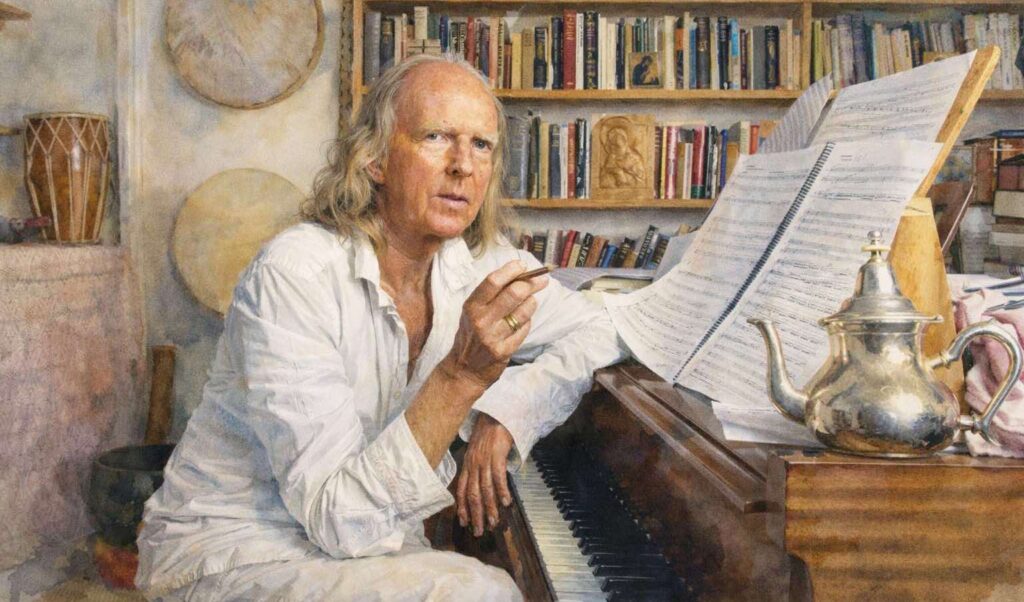
Early Life, Education, and First Musical Influences
Born in London into a Scottish Presbyterian family, Tavener showed musical promise at a very young age, composing from around three years old and later studying piano and organ as a child. He won a music scholarship to Highgate School where he first penned works for orchestra and explored the possibilities of composition.
His formal training took place at the Royal Academy of Music in London, under teachers such as Sir Lennox Berkeley and David Lumsdaine. During this formative period he absorbed a diversity of techniques, ranging from modernist experimentation to harmonic exploration. Tavener’s early works, including the cantata The Whale — premiered in 1968 by the London Sinfonietta — showed a bold avant-garde presence that marked him as a composer of curious genius.
Artistic Maturity
Although Tavener’s initial compositions were adventurous and sometimes dissonant, his artistic voice began to coalesce around spirituality in the mid-1970s. A watershed moment came in 1977 when he converted to Eastern Orthodox Christianity, a change that profoundly shaped his musical language. From this point, his music became less about academic innovation per se and more about meditative spiritual depth, drawing on Orthodox chant, Byzantine aesthetics, and sacred ritual.
Works such as Orthodox Vigil Service, Akathist of Thanksgiving, and The Protecting Veil reflect this mature period, where contemplative stillness, liturgical resonance, and an almost minimalist sensibility became hallmarks of his style.
Importance
Tavener’s importance lies not only in his craftsmanship but in the way he reframed the role of faith within the classical tradition. Unlike composers who used sacred themes as surface inspiration, Tavener embedded spirituality into structural and harmonic frameworks, allowing his music to function as an aural form of meditation. His works found resonance both within concert halls and places of worship, expanding how contemporary audiences experienced serious music.
Greatest Works of John Tavener
Among his most celebrated pieces are:
- The Whale – his breakthrough dramatic cantata based on the Jonah narrative, which brought him international recognition.
- The Lamb – a simple yet haunting choral setting of William Blake’s poem that has become a modern choral staple.
- The Protecting Veil – a luminous cello and strings composition inspired by Orthodox devotion to the Virgin Mary, noteworthy for its haunting beauty and emotional depth.
- Song for Athene – known worldwide after its performance at the funeral of Diana, Princess of Wales, this piece exemplifies Tavener’s ability to touch profound emotional and spiritual chords.
- The Veil of the Temple – a monumental eight-hour choral and orchestral vigil that synthesizes influences from multiple religious traditions into a theatrical spiritual journey.
These works represent both the scope and the sincerity of his compositional mission — to create music that speaks to personal faith and universal contemplation.
Composition Style and Influence on Others
John Tavener’s music is characterized by spacious textures, modal harmonies, and a tonal simplicity that often borders on the mystical. His use of religious texts, chant-like phrasing, and sustained sonic atmospheres places him alongside contemporaries such as Arvo Pärt in the broader milieu of spiritual minimalism. Yet Tavener’s voice remains undeniably his own.
His influence resonates across classical piano music, contemporary classical ensembles, and choral repertoires worldwide, and his works are frequently featured in classical music blogs and classical music reviews for their emotional immediacy and contemplative power.
Why This Composer Is Important
Tavener bridges the sacred and the secular in a way that reinvigorated the classical tradition for a new generation: he made deep spirituality accessible within a modern musical context and demonstrated that contemporary serious music can still carry profound existential meaning. His compositions have become touchstones in classical music catalogs and are often highlighted in classical music magazines as exemplary of how tradition and innovation can unite.
Final Thoughts
Sir John Tavener’s legacy is not merely in the notes he wrote but in the quiet spaces between them, the contemplation he invites, the transcendent stillness he evokes, and the spiritual curiosity he inspires. In a world often drowning in sound, Tavener’s music remains an oasis of silence, reflection, and grace.
Sources:
- Encyclopaedia Britannica – Sir John Tavener bio
- Wikipedia
- British Music Collection – Tavener overview
- News on The Veil of the Temple revival
#JohnTavener #ContemporaryClassical #ClassicalPianoMusic #ClassicalMusicReviews #MusicMagazineEstonia #ArtAndCultureNewsEstonia #ClassicalMusicBlogs #ClassicalMusicLabel