Long before European polyphony crystallized into notation-heavy systems, Iran had already developed a sophisticated modal architecture, court repertory, and philosophical musicology that shaped the sound world of a vast region, from Central Asia to the Mediterranean. Persian musicians were not merely performers; they were system builders, poets, philosophers, and cosmologists. Unfortunately, Iran’s history of music is a neglected part of history.
Yet Western music historiography has persistently marginalized Iran’s contribution. When medieval theory is discussed, credit is often funneled toward church and liturgical music and the little tiny bit of non-western music is credited as “Arab” or “Islamic” music in a homogenized sense, erasing the distinct Persian intellectual and artistic foundations that shaped modal theory, instrument design, and court repertoire. The result is a distorted narrative: Europe appears as the sole engine of structured music theory, while Persia and Arabia are reduced to folklore.
That view is historically indefensible.
From the Sasanian courts to the Abbasid intellectual salons, Persian musicians defined modal systems, rhythmic cycles, and aesthetic philosophy that deeply influenced Ottoman, Arab, and even Andalusian traditions. What survives today is fragmented, but what survives is enough to demonstrate that Iran’s musical past was one of the most advanced in the pre-modern world.
Below is a closer look at some of the most important figures, beginning with the legendary court musicians of late antiquity and moving into the towering theorists of the medieval era.
The Sasanian Golden Age of Music
Barbad (7th century)
If Persian music has a mythic founder, it is Barbad.
Barbad served at the court of Khosrow II (r. 590–628 CE). His name appears in:
- Ferdowsi’s Shahnameh
- Al-Thaʿālibī’s historical writings
- Later Persian chronicles and musicological treatises
According to tradition, Barbad systematized music into:
- 7 royal modes (associated with the days of the week)
- 30 derivative modes (for the days of the month)
- 360 melodies (for the days of the year)
This cosmological structuring anticipates later modal systems such as the dastgāh. While no notated music survives, the structural idea of modal cycles likely informed later Persian theory.
Barbad was also credited with composing narrative pieces reflecting political events. One famous example, the “Song of the Throne,” reportedly celebrated royal glory. These compositions survive only through textual references, not sound.
His instrument was the barbat, ancestor of the oud (which itself is the ancestor of the guitar)
Barbad’s music is lost, but his conceptual system may be the skeleton beneath centuries of modal thought.
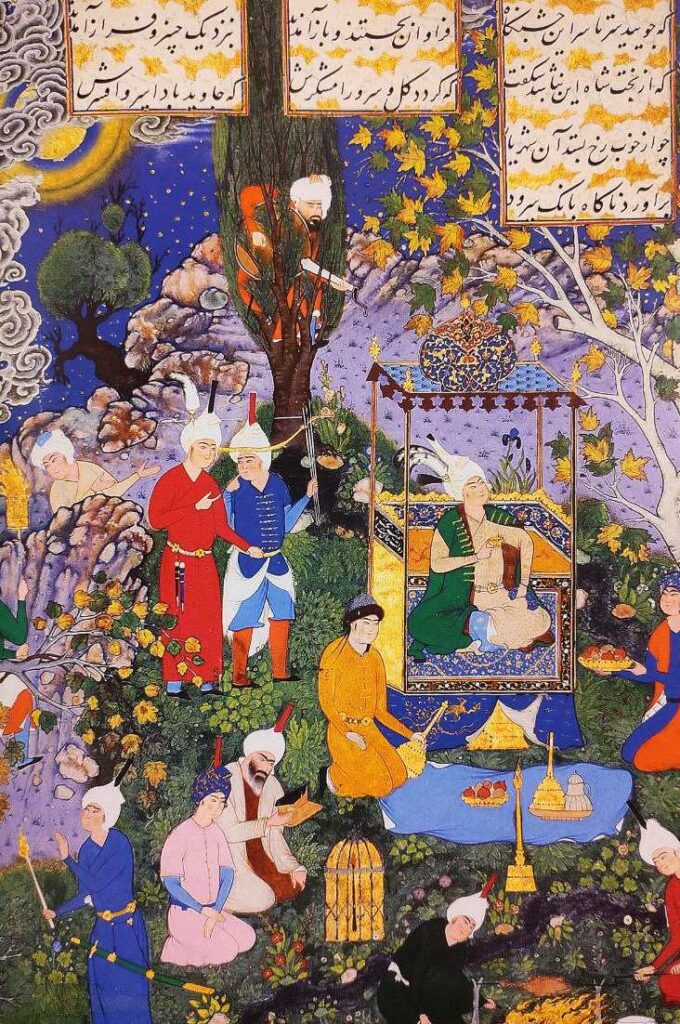
Nakisa
Nakisa was a harpist at the same court. His name appears in:
- The Shahnameh
- Classical Persian literary sources
- Court legends about Khosrow II
He is often depicted performing alongside Barbad, suggesting a structured court ensemble tradition. No compositions survive, but his presence indicates that instrumental specialization and ensemble court music were already developed in Sasanian Iran.
Bamshad
Mentioned in medieval Persian sources, Bamshad was another musician of the Sasanian court. Though biographical details are sparse, the consistency of his mention across texts suggests he was not a minor figure.
Ramtin
Also referred to in Persian literary sources, Ramtin is said to have been a master musician during Khosrow II’s reign. Like others of the era, his work survives only as literary memory.
Sarkash
Sometimes portrayed as Barbad’s rival, Sarkash appears in court narratives. His mention reveals a competitive and vibrant artistic culture at the Sasanian court.
The Philosophical Architects of Music
After the Arab conquest, Persian intellectual culture did not collapse—it transformed. Music theory became systematized through philosophy, mathematics, and science.
Abu Nasr al-Farabi (c. 872–950)
Al-Farabi’s monumental work:
- Kitāb al-Mūsīqā al-Kabīr (The Great Book of Music)
This is one of the most detailed medieval music treatises ever written. It covers:
- Interval theory
- Modal systems
- Rhythm
- Instrument classification
- Aesthetic philosophy
Farabi integrated Greek theory (especially Aristotle and Ptolemy) with Persian musical practice. He was not just theorizing abstractly, he described real modal systems in use.
The treatise survives in manuscript form and has been partially translated. No actual compositions are securely attributed to him, but he was known as a skilled instrumentalist.
Legend has it that Farabi was such a master of the oud that he could produce perfectly tuned melodies even from an instrument that was out of tune. It is said that in a single performance he could make listeners cry, laugh, dance, and even fall asleep solely through the power of his playing.
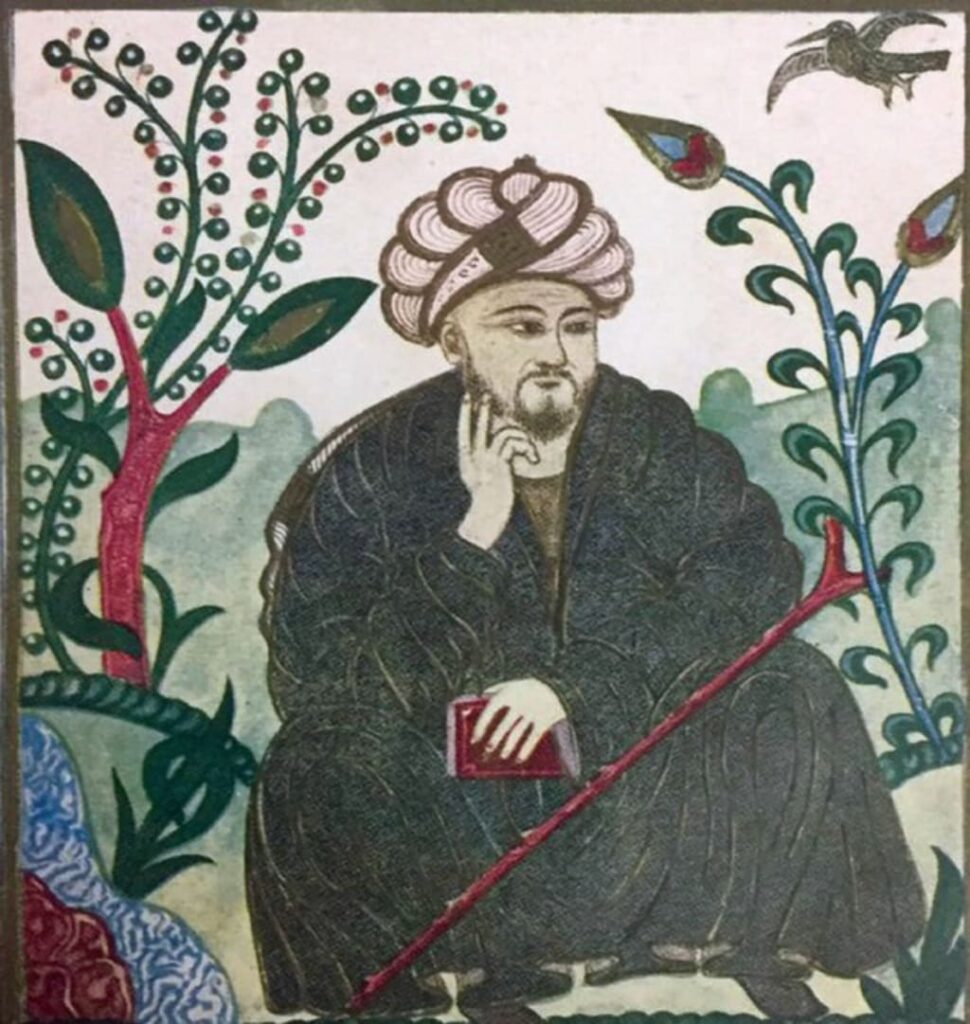
Ibn Sina (Avicenna) (980–1037)
Music chapters appear in:
- Kitāb al-Shifā (Book of Healing)
- Dāneshnāmeh-ye ʿAlāʾī
Ibn Sina is best known for his groundbreaking medical discoveries and writings, but like many scholars of his time, he worked across numerous disciplines. In addition to being a great physician (some even call him the father of modern medicine) and an accomplished astronomer, he was also a music theorist. It is not known whether he was a performer or composer, but based on the depth and precision of his theoretical writings, it is reasonable to assume that he was at least musically trained, if not an active practitioner. He treated music as a mathematical science and refined modal classification and interval analysis.
He left no surviving compositions, but his theoretical contribution influenced centuries of Persian and Ottoman music thought.
Ibrahim al-Mawsili (742–804)
Though active in Baghdad under the Abbasids, he was of Persian origin.
Sources:
- Al-Isfahani’s Kitāb al-Aghānī (Book of Songs)
He was both a composer and performer. Many songs are attributed to him in textual sources, though melodies are lost.
Ishaq al-Mawsili (767–850)
Son of Ibrahim.
Also extensively mentioned in Kitāb al-Aghānī.
He was known for:
- Formalizing melodic forms
- Refining court repertoire
- Being a central musical authority in Baghdad
Again, works survive only through written accounts.
Safi al-Din al-Urmawi (1216–1294)
One of the most crucial figures in Middle Eastern music theory.
Major works:
- Kitāb al-Adwār
- Risāla al-Sharafiyya
He developed:
- A 17-tone scale
- Systematic modal categorization
- Early forms of notation
Unlike earlier figures, his theoretical system directly influenced Ottoman and Persian modal traditions.
His notation survives in manuscripts, though performance practice must be reconstructed.
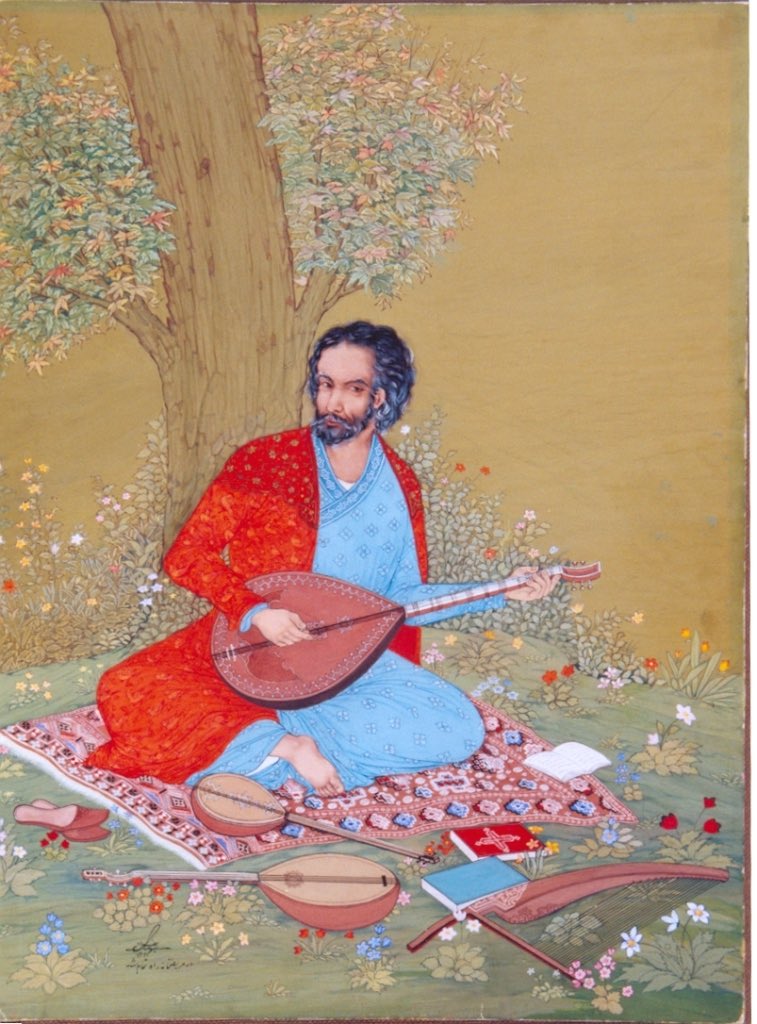
Transmission and the Radif Era
Though later chronologically, masters such as Mirza Abdollah and Darvish Khan preserved the radif repertory that likely descends, structurally if not melodically, from these earlier systems. Their work anchors continuity between ancient modal thought and modern Persian classical music.
Poets as Musicians? The Sonic Intelligence of Persian Verse
There is a persistent and fascinating historical hypothesis: that some of Persia’s greatest poets were not merely writers of verse, but active performers, perhaps even singers, who presented their works in courtly or semi-courtly settings accompanied by music.
While there is no surviving notation, no confirmed documentation of formal performances, and no direct evidence that poets like Hafez, Rumi, or Saadi were professional musicians, the idea is not implausible. In medieval Persia, poetry was not a silent literary object. It was voiced, chanted, recited rhythmically, and often intertwined with melodic frameworks. The separation between poet, reciter, and musician was far less rigid than modern academic categories suggest.
Some historians argue that in the courts of Shiraz, Konya, and other cultural centers, poetry would have been performed in musically structured gatherings. Whether the poets themselves sang or collaborated with court musicians remains uncertain. But what is undeniable is the extraordinary musicality embedded in their language.
The Metric Architecture of Persian Poetry
Persian classical poetry is built on the quantitative system of ʿaruz, a complex metrical structure based on long and short syllables. Mastery of this system requires not only literary sensitivity but rhythmic precision comparable to compositional thinking.
Hafez’s ghazals unfold with cadential logic.
Rumi’s ecstatic verses pulse with cyclical drive.
Saadi’s narrative clarity often rests on balanced rhythmic symmetry.
Even if these poets were not active instrumentalists, they possessed acute rhythmic awareness. Their poetry moves with breath control, tempo shifts, internal repetition, and refrains that resemble compositional devices. The ghazal form itself functions almost like a modal improvisation: a recurring radif (refrain) anchors each couplet, while semantic development flows freely, much like a musician navigating a dastgāh.
Rumi and the Sound of Ecstasy
In the case of Rumi, the musical connection is even more direct. His poetry is inseparable from the Sufi practice of samāʿ, the spiritual listening ceremony that later evolved within the Mevlevi tradition. Whether Rumi himself formally performed music is unclear, but his environment was saturated with it. The ney (reed flute) becomes a central metaphor in his Masnavi, symbolizing both sound and spiritual longing.
Hafez and the Courtly Soundscape
Hafez lived in a milieu where court musicians were active, and his poetry frequently references instruments, wine gatherings, singers, and melodic ecstasy. Some scholars suggest his verses were likely sung shortly after their composition. Even today, many of his ghazals are inseparable from Persian vocal repertoire.
Whether he personally sang them or not may ultimately be less important than this: his poetry behaves like music.
Saadi and Narrative Musicality
Saadi’s works, show a deep sensitivity to cadence and pacing. His didactic storytelling moves with an almost compositional restraint. The alternation between prose and verse in Gulistan suggests a consciousness of tonal contrast and rhythmic variation.
The Silence of Documentation
There are no preserved scores.
No contemporary accounts explicitly describing these poets performing as musicians.
No treatises naming them as composers.
Medieval Persian culture was overwhelmingly oral. Performance often preceded documentation. If melodies existed, they may have been transmitted for generations before disappearing in political upheavals, invasions, or simple historical erosion.
Musical Consciousness Beyond Performance
Even if Hafez, Rumi, Saadi and other Persian poets never formally performed music, their work demonstrates:
- Sophisticated rhythmic architecture
- Refrain structures akin to musical form
- Tonal sensitivity in vowel color and consonant flow
- Imagery rooted in instrumental and vocal culture
In a civilization where music theory was treated as mathematics and cosmology, it would be naïve to imagine that poets were isolated from that sonic intelligence.
Perhaps they were singers.
Perhaps not.
What is certain is this: Persian poetry and Persian music grew from the same soil. And in that soil, rhythm was foundational.
A Civilization of Sound, Mostly Forgotten
Iran’s musical history stretches back millennia. The Achaemenid courts had ceremonial music. The Parthian and Sasanian empires cultivated artistic patronage rivaling Rome, Byzantium, India, and China. The medieval Persian scholars mathematized music centuries before Renaissance Europe.
And yet, most of the names are lost.
For every Barbad remembered in epic poetry, dozens vanished into silence. For every manuscript preserved in Istanbul or Tehran, hundreds perished in invasions, fires, and neglect.
To study global music history without Iran is to read a book with its central chapters torn out.
Reclaiming these names is not nostalgia. It is intellectual honesty.
And perhaps, one day, reconstruction, reinterpretation, and bold new composition will reconnect the fragments into living sound again.
#PersianMusic #IranianMusicHistory #Barbad #Farabi #IbnSina #SafiAlDinUrmawi #Hafez #Rumi #Saadi #SasanianEmpire #IslamicGoldenAge #PersianPoetry #Radif #Dastgah #MusicTheory #Ethnomusicology #MiddleEasternMusic #CulturalHeritage #AncientMusic #MusicHistory