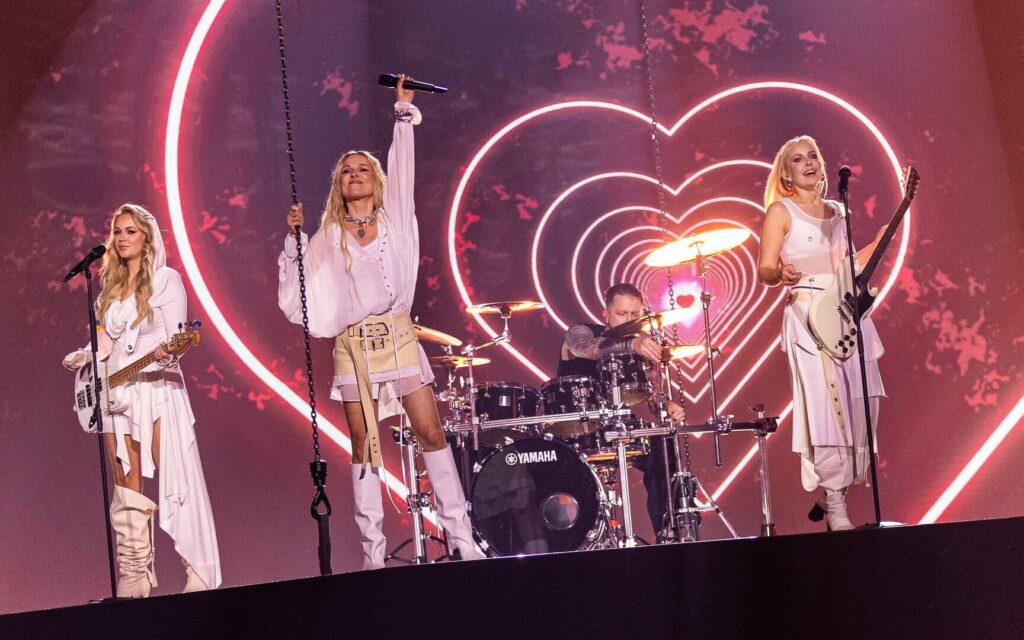
Last night at the national final Eesti Laul 2026, Estonia chose its representative for the Eurovision Song Contest in Vienna: Vanilla Ninja and their song “Too Epic to Be True.” The veteran all-female band clinched victory in a tight competition decided by jury and public vote.
But in 2026, Eurovision is anything but neutral.
Eurovision in a Politically Explosive Year
This year’s Eurovision unfolds against a backdrop of international protest and deep moral fractures. Several countries, including Ireland and Spain, have withdrawn in protest against Israel’s ongoing military actions in Gaza, actions widely condemned by activists and human rights organisations as genocidal.
In this climate, choosing to participate in Eurovision is not a simple celebration of pop music. It has become, for some, a symbolic decision, a public position in a deeply charged political landscape.
Estonia Stands With Israel — Implicitly on the Eurovision Stage
By sending a band to perform in Vienna alongside delegations from Israel and nations openly debating boycott, Estonia’s broadcaster ERR and national selection Eesti Laul have placed the country on a particular side of the cultural moment. Participation here is not neutral. It amounts to a tacit endorsement of the status quo, no matter how much artists and fans try to frame it as “just music.”
Vanilla Ninja could call themselves artists, but art, at its best, reflects conscience and courage. Real artists push back against suffering and speak for the voiceless. When singers step onto a stage that’s now politically loaded, there’s a choice: to use that platform for humanity or to let it echo with indifference.
In this sense, those who prioritize commercial success, fame, or spectacle over moral clarity don’t embody the true spirit of artistry. They are entertainers, not truth-tellers.
The Role of Art in Crisis
For decades, Eurovision has wrapped itself in the language of inclusivity and political neutrality. Yet when Russia launched its illegal invasion of Ukraine, that neutrality quickly dissolved. The contest took a stand against aggression, Russia was banned, and Estonia was among the first to demand that exclusion, a moment when cultural institutions aligned with moral clarity. A moment that gave artists and countries a chance to stand their ground and keep their heads high up with what they achieved.
But in 2026, Eurovision, and many of the countries participating, including our own Estonia, have revealed something far more uncomfortable: that “humanity” and “justice” appear to operate on a selective scale. When Russia invaded Ukraine, solidarity was immediate and loud, and rightly so. Supporting Ukraine remains urgent and necessary.
Yet when it comes to Palestine, the tone shifts. The moral clarity blurs. What was once framed as a universal principle now feels conditional. Palestine becomes a background issue, an inconvenient subject better softened, reframed, or avoided altogether.
Broadcasters such as ERR speak fluently about unity and European values, yet remain conspicuously restrained when it comes to naming the genocide in Gaza. Silence, in this context, is not neutrality. It is alignment. And in 2026, that alignment is visible on the Eurovision stage as much as in any parliamentary chamber.
Estonia’s entry might be catchy or “too epic to be true,” but that phrase now reads differently. In a world where genocide isn’t abstract, the cultural choices of nations and artists reverberate far beyond a stage. European music isn’t just entertainment, it’s a battlefield of values.
#Eurovision2026 #Estonia #VanillaNinja #EestiLaul #ERR #EurovisionPolitics #StandWithPalestine #Gaza #CulturalBoycott #MusicAndPolitics #HumanRights #ArtAndConscience #JusticeMatters #NoToGenocide #EuropeDecides