Non-duality by Ben MK is a release that redefines how we listen to music. Though presented technically as a single, the immense conceptual weight and near 20-minute runtime easily earn this release the full, immersive EP treatment it demands. The piece marks the official debut of the composer’s “Tonefield” composition method; a minimalist framework designed to extract the absolute fullest possible harmonic color from the simplest musical raw materials. The result is a gorgeous, hypnotic solo piano work that balances strict structural clarity with a profound, breathing emotional immediacy.
The Melody of Perception
Right from the opening notes, the music breaks conventional boundaries. There is no traditional, singing melody line explicitly laid out for the listener. Instead, the piece relies on a crystalline cascade of arpeggios acting as a continuous ostinato. What makes the piece brilliant is its psychological depth: the melody changes based entirely on the focus of the listener.
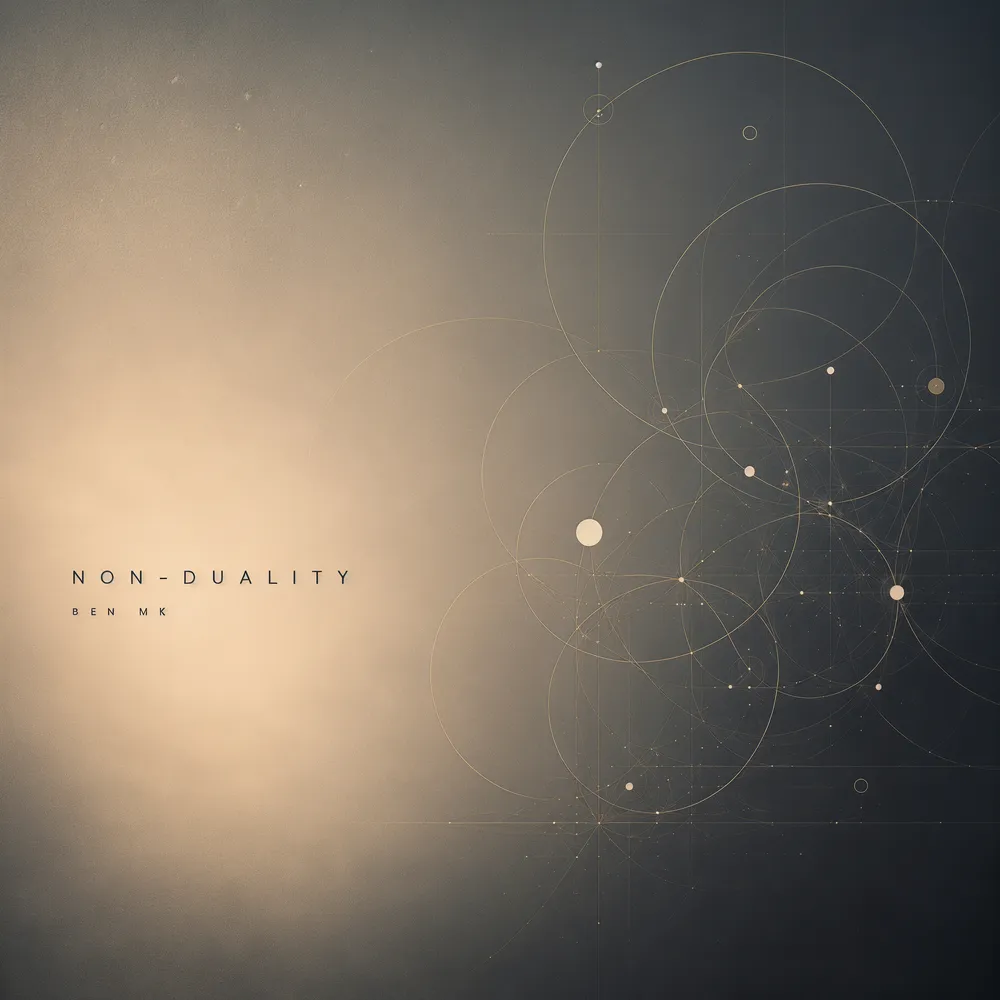
Built upon six independently repeating piano patterns, the track creates a shifting matrix of sound. As these loops phase against one another, the “notes in between” rise to the surface, tricking the ear into hearing hidden, ghostly melodies. The lower bass notes repeat with a grounding, hypnotic weight, leaving the upper layers to shimmer. Depending on which layer your ear decides to follow at any given second, you are handed an entirely different piece of music. It is a brilliant subversion of the traditional horizontal melody line.
The Architecture of Oneness in Non-duality by Ben MK
Harmonically, the entire 20-minute architecture is built not upon a shifting chord progression, but upon one single underlying collection of notes, a single, massive harmonic plane. The piece unfolds across two interconnected parts, each exploring a different modal field while sharing the exact same sonic DNA. By locking the harmony into a single static field, the composition achieves what the artist calls “emergent harmony.” Without the distraction of chord changes, the listener becomes acutely aware of the natural acoustic beauty, the piling overtones, and the sheer density of the piano strings vibrating in sympathy with one another.
This radical harmonic stasis connects directly to the historic masterworks of American minimalism. The instinct to link this to a 17-minute single-chord marathon is spot-on. In 1970, Steve Reich famously composed Four Organs, a 15-to-20-minute piece entirely built upon a single, locked dominant eleventh chord that gradually elongates over a steady pulse. Similarly, Philip Glass explored this intense focus in early process works like Music in Contrary Motion (1969) and Dance No. 2 (1979), the latter of which sustains an immersive hypnotic meditation built almost entirely around a single C major chord for over twenty minutes. Like these landmarks, this release proves that staying in one place harmonically allows the listener to notice the vast universe contained inside a single sound.
The Art of the Micro-Variation
While this radical restraint feels intensely modern, it actually shares a profound, poetic DNA with classical history. Consider the first movement of Beethoven’s Symphony No. 6 (Pastoral). In the development section of that masterpiece, Beethoven famously takes a simple string arpeggio figure and repeats it 14 times consecutively over a static harmony. He did this to capture the repeating, cyclical patterns of nature, the wind, the fields, and the trees.
Just like Beethoven, the secret key here lies in micro-expression. On paper, the notes of these six repeating patterns are exactly the same. But because a human being is sitting at the keys, no two repetitions are ever truly identical. Each strike of the hammer features a microscopic variance in velocity, weight, and timing. As the patterns continuously overlap, the piece transforms from a rigid mathematical process into a living, breathing emotional organism.
In Beethoven’s case, there are clear expression markings that change the dynamic and feel of each repetition. While I haven’t seen the sheet music for Non-duality, the recorded result shows that these expressive changes are much more subtle. The dynamic as a whole does not drastically shift, but the micro-dynamics within the performance are constantly breathing. Sometimes the bass, sometimes the upper arpeggio, and sometimes the middle notes are hit with a slightly stronger touch, creating a fluid, ever-shifting expression throughout the entire piece
Stillness in Movement
The composition beautifully achieves its goal of revealing stillness in movement and movement in stillness. It is a piece that warmly invites both casual, ambient passive-listening and deeply focused, analytical immersion.
By stripping away the superficiality of modern pop structures and chord progressions, we are given something deeply meditative. It is a stunning reminder that true richness is found through restraint, and absolute completeness can be discovered in the simplest of forms. Engaging with Non-duality by Ben MK ultimately leaves the listener transformed, proving that structural rigor and raw human emotion are one and the same in their core.
#BenMK #NonDuality #Tonefield #Minimalism #MinimalistMusic #SoloPiano #ModernClassical #Neoclassical #AmbientPiano #ProcessMusic #SteveReich #PhilipGlass #ContemporaryClassical #EmergentHarmony #NewMusicRelease