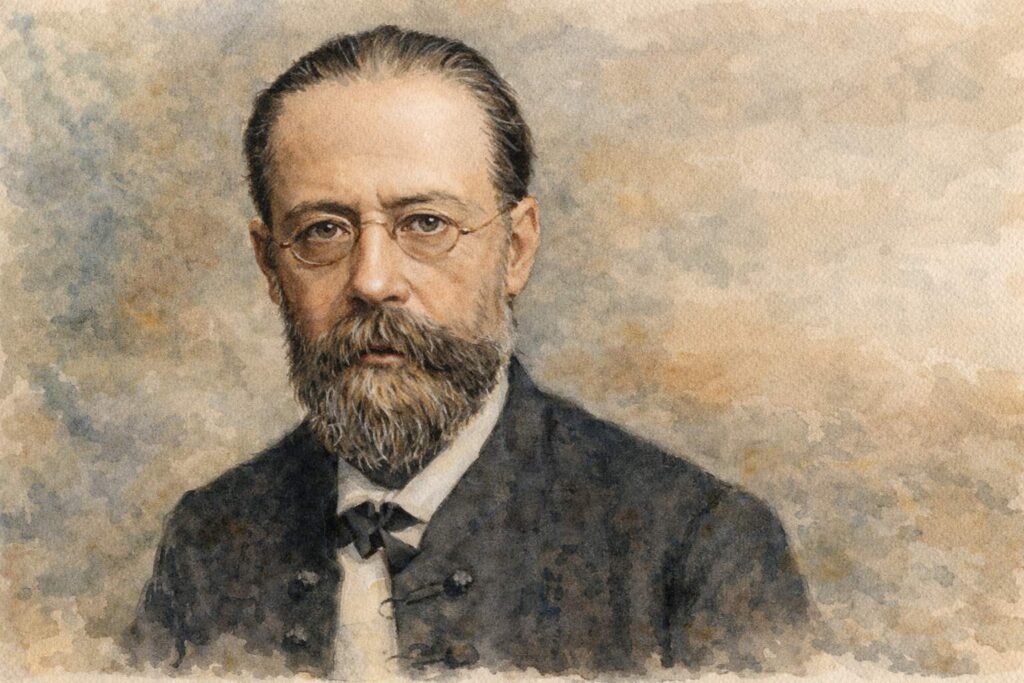
Bedřich Smetana (2 March 1824 – 12 May 1884) is widely regarded as the pioneer of Czech national music. His music fused folk‑tunes, dramatic storytelling, and a distinctly Czech language into a sound that was at once modern and deeply rooted in the country’s cultural identity. For more than a decade Smetana served as the director of the Prague National Theatre, where he introduced the world to his operas “The Bartered Bride” and “The Kiss”. Later he turned his talents to symphonic poems that crystallized Czech nationalism: the four‑movement “Má vlast” (“My Country”) remains the quintessential statement of Czech musical nationalism.
Early Life, Education, and First Musical Influences
Bedřich Smetana was born in Litomyšl, a small town in the Kingdom of Bohemia, then part of the Austrian Empire. His family was of the Czech middle class; his father, a civil servant, valued education and encouraged his children’s artistic interests. From a very young age Smetana was exposed to the vibrant folk traditions that surrounded him. Church choirs, village festivals, and the daily hum of rural life furnished him with a rich palette of melodic and rhythmic patterns that would later become a cornerstone of his compositional voice.
In 1858 Smetana entered the Vienna Music Academy (Akademie der Musik in Wien), a leading institution in the empire’s musical life. There he studied harmony under Anton Bruckner and counterpoint with Anton Diabelli. The rigorous, German‑style training he received at Vienna gave him a solid foundation in classical technique, even as it stood in contrast to the Czech idiom that would come to dominate his later work.
A year later he transferred to the Prague Conservatory, a hub of Czech musical nationalism. Under the tutelage of violin virtuoso Josef Slavík and composer‑pianist Antonín Vranický, Smetana deepened his connections to the burgeoning Czech music scene. In 1865 he held his first public concert, presenting an original overture that would later be revised and titled “The Four Seasons.” His exposure to Prague’s artistic community would shape his growing sense of a distinct Czech musical identity.
Between 1865 and 1868 Smetana worked as a freelance composer, pianist, and conductor, performing throughout Vienna and Prague. During this period he wrote his first opera, The Kiss, and a handful of orchestral pieces that already hinted at a nascent nationalist style. His early musical influences were a blend of the lyrical lyricism of Franz Schubert and Hugo Wolf, the dance‑infused rhythms of Johann Strauss II, and, most importantly, the folk melodies and rhythms that pervaded Czech village life. These elements, combined with the spirit of the Czech national awakening that was sweeping Bohemia, would crystallize into the unique voice that would make Smetana the founder of Czech national music.
First Musical Influences
- Franz Schubert and Hugo Wolf – Melodic lyricism that Smetana emulated.
- Johann Strauss II – The influence of dance rhythms appears in The Bartered Bride.
- Folk Traditions – Czech folk songs, hornpipe dances, and local hunting tunes were vital sources, especially after he moved to Prague.
- Czech National Awakening – The rise of Czech literature and the press cultivated a national consciousness that Smetana would later embody musically.
Artistic Maturity
The National Theatre Years (1873–1883)
Smetana’s tenure at the Prague National Theatre (the first major national theatre built expressly for Czech productions) marks his artistic apex. Here he:
- Launched “The Bartered Bride” (1875) – A comic opera that became an international sensation.
- Staged “The Kiss” (1876) – Though not as successful as Bartered Bride, it still cemented his reputation.
- Composed “The Brandenburgers in Bohemia” (1877) – A large-scale, semi‑dramatic piece reflecting the tumultuous history of Bohemia.
During this decade, he refined his orchestral language, experimented with programmatic elements, and began composing the symphonic poems that would define his legacy.
Later Works
- “The Moldau” (Vltava) (1884) – The opening movement of Má vlast, a poetic depiction of the Vltava River.
- “Karel Jaromír Erben’s “The Storks” – A ballet suite that showcases his lyrical capacity.
- Various orchestral preludes and chamber works – These are lesser‑known but illustrate his evolving style.
Importance in Music History
- Founder of Czech National Music; Smetana provided a template for infusing folk elements into a modern symphonic form, a model followed by later composers such as Dvořák, Janáček, and even Gustav Mahler.
- Bridge Between Germanic Tradition and National Expression; While he studied under German masters, his output remains unmistakably Czech.
- First National Opera with International Reach; The Bartered Bride remains one of the most frequently performed Czech operas worldwide.
- Pioneer of Programmatic Orchestral Poetry; Má vlast set a standard for musical nationalism that can be seen in similar works by composers across Europe.
Greatest Works
| Genre | Title | Year | Significance |
|---|---|---|---|
| Opera | The Bartered Bride(Nudba pro burcov) | 1875 | Internationally acclaimed; first Czech opera to be translated into multiple languages; uses Czech folk idioms. |
| Opera | The Kiss (Láska z pod svahu) | 1876 | Showcases lyrical romance; less successful but still crucial to his development. |
| Symphonic Poem | The Moldau (Vltava) – Má vlast | 1884 | Symbolizes Czech pride; remains one of the most recognizable programmatic pieces. |
| Symphonic Poem | The Brandenburgers in Bohemia | 1877 | Political commentary; showcases Smetana’s use of orchestral drama. |
| Other | The Four Seasons(Four Seasons Overture) | 1872 | Early orchestral work; demonstrates his growing confidence. |
“Má vlast” in Detail
Má vlast consists of four symphonic poems:
- “Vltava” – The flowing river, a portrait of the Czech landscape.
- “Šárka” – A narrative about a young woman and her tragic fate.
- “Polka from Bohemia” – A lively dance.
- “The Moldau” – A musical summary of the Vltava’s course and Czech nationalism.
Composition Style
Harmonic Language
- Romantic Idiom: Rich, chromatic harmonies reminiscent of Wagner and Brahms.
- Modal Flavors: Use of modes such as Dorian and Phrygian, reflecting folk scales.
Rhythmic & Melodic Characteristics
- Czech Folk Rhythms: Swinging 2/4 and 3/4 patterns from polkas, dumky, and hornpipe.
- Lyrical Lines: Vocal‑like melodies that mimic Czech folk songs.
- Motivic Development: Repetition and variation of small motifs to create cohesion.
Orchestration
- Large‑Scale Ensembles: Full Romantic orchestras; occasionally expanded to include a chorus.
- Colorful Timbres: Utilization of brass fanfares, woodwind solos, and unique percussion (e.g., bass drum, glockenspiel) to evoke pastoral scenes.
Influence on Others
| Composer | Impact of Smetana | Examples |
|---|---|---|
| Antonín Dvořák | Smetana’s blending of folk and symphonic elements inspired Dvořák’s Slavonic Dances and American Sketches. | “Humoresques,” “Slavonic Dances No. 9.” |
| Leoš Janáček | Smetana’s use of speech rhythms and folk motifs encouraged Janáček’s Káťa Kabanová and Sinfonietta. | “Locomotive” from Sinfonietta. |
| Jean Sibelius | Influenced Sibelius’s nationalistic style and his approach to landscape depiction. | “Valse Triste” (though not a symphonic poem, Sibelius was influenced by Smetana’s mood). |
| Richard Wagner | While Wagner’s chromaticism influenced Smetana, Smetana’s emphasis on national identity was a counterpoint to Wagner’s Germanic focus. | Smetana’s The Brandenburgers in Bohemia shows Wagnerian grandeur but Czech national content. |
Smetana’s legacy is also felt in the modern interpretation of national music. His works are staples in Czech education and frequently used in film and popular culture to evoke a sense of Czech heritage.
Why Bedřich Smetana is Important
- Cultural Identity – He articulated Czech national consciousness at a time when the Austro‑Hungarian Empire sought to suppress it.
- Musical Innovation – By integrating folk idioms into high art, he expanded the possibilities of Romantic music.
- Bridge Between Traditions – He respected Germanic musical education while championing his native heritage, thereby creating a unique synthesis.
- Global Reach – His operas and symphonic poems continue to be performed worldwide, proving that music can transcend borders while staying rooted in its culture.
- Educational Value – His works are used in conservatories to teach composition, orchestration, and the integration of folk elements.
Final Thoughts
Bedřich Smetana’s life and music are a testament to the power of cultural self‑assertion through art. His compositions not only entertained but also galvanized a nation’s sense of identity during a period of political suppression. Today, his music remains vital, both as an artistic masterpiece and as a cultural beacon. As we listen to The Moldau’s winding melody or watch the humor of The Bartered Bride unfold, we are reminded of how deeply music can reflect the heart and soul of a people.
Sources:
#Smetana #CzechMusic #BedřichSmetana #MáVlast #BarteredBride #CzechNationalism #RomanticMusic #ClassicalMusic #MusicHistory #Opera #SymphonicPoems #CzechHeritage #MusicLovers