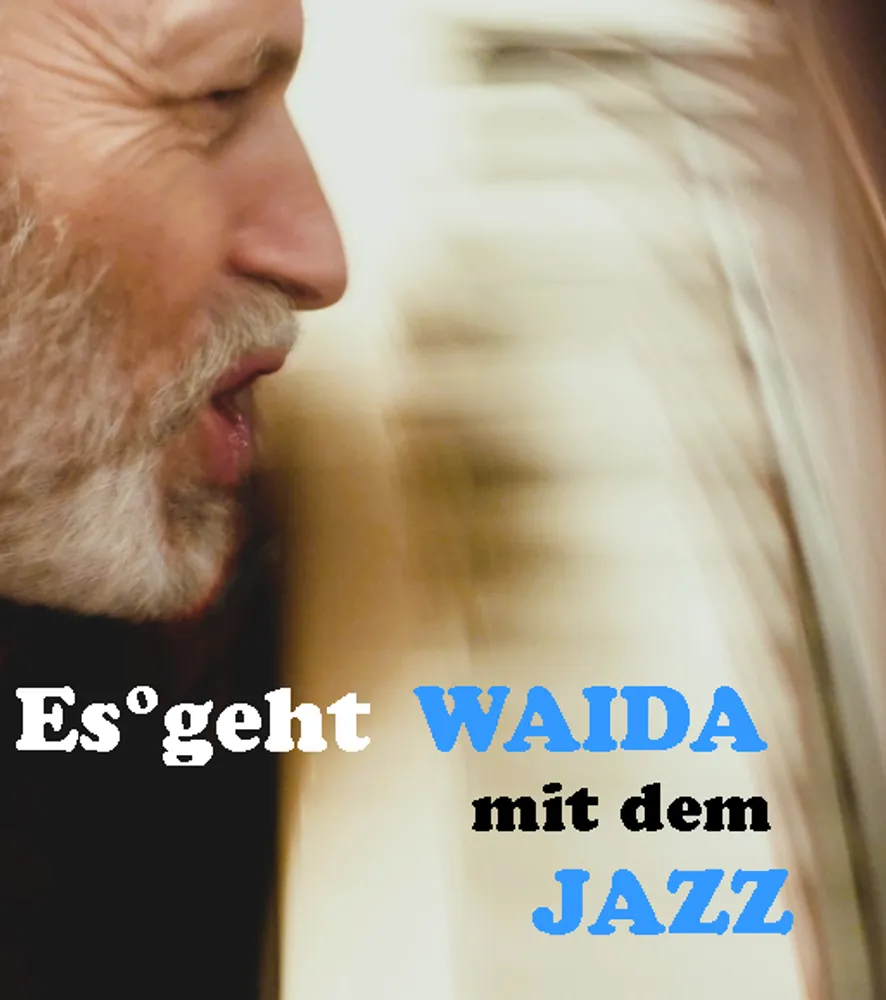
WAIDA mit dem JAZZ by Es°geht Waida is an evolving collection of original jazz compositions by German musician and composer Sven Waida. Rather than following the traditional concept of a finished album, the project takes the form of a continuously expanding musical collection, with new compositions released individually and added to a shared stream. Since January 2026, Waida has been releasing his music approximately weekly, bringing together an extensive body of work under the title WAIDA mit dem JAZZ.
At the centre of this project lies a particular understanding of jazz: one rooted in improvisation, harmonic exploration and personal expression, while maintaining a strong connection to melody and songwriting.
One of the first things that caught my attention when listening to the collection was the piano. Its vintage sound plays a central role in shaping the musical atmosphere. There is something unmistakably historical about its timbre, an almost tangible sense of age and character. After reading the artist’s description, I discovered that most of the recordings were made on a historic Grotrian-Steinweg grand piano, built in 1881. With the exception of “A Thousand Miles Away From Me” and “Love Is Certain – LIVE”.
Indeed, this instrument is remarkable. I can almost imagine the dust accumulated over decades and the aged strings vibrating beneath the hammers. Interestingly, although Waida mentions that he would have preferred to record on a newer grand piano, I would argue that the instrument’s particular character is one of the collection’s greatest strengths. Its sound is distinctive, intimate and occasionally unpredictable. It gives the music a personality that would be difficult to reproduce with a modern concert grand.
The piano’s acoustic character also creates an interesting relationship with the harmonic language. Its resonance and overtone structure give certain notes an unusual richness, sometimes suggesting a subtle instability in their tonal colour. Combined with Waida’s sophisticated chord progressions, this creates an atmospheric soundscape that feels both familiar and unconventional.
Harmonic language and improvisation
The harmonic vocabulary is another interesting aspect of this project. Waida makes extensive use of extended chords, including major and minor sevenths, ninths and altered extensions. His approach also incorporates harmonic movements beyond conventional functional jazz progressions, with modal interchange, secondary dominants and tritone substitutions appearing in his compositional language.
An interesting example can be found in “es°lindo”. The composition begins with an F major tonal centre, moving through A7, Bbmaj and Eb7 before introducing D7 and a more recognisable G7–C7 progression. The Eb7 introduces a borrowed dominant colour. This movement between familiar functional harmony and chromatic alterations gives the progression a distinctive character.
The refrain takes the harmonic exploration further, moving through E major, A major, Db7 and finally arriving at F major; the “home” chord. Rather than remaining within a single diatonic framework, the progression moves through harmonic areas, creating unexpected connections between chords that are not necessarily related through conventional tonal functions.
What makes these progressions interesting is that they do not necessarily sound as complicated as they are on paper. The music retains a certain fluidity, and the harmonic changes are integrated into melodic structures that remain accessible to the listener.
From an improvisational perspective, these compositions are considerably demanding, depending on the individual progression. The more conventional ii–V–I movements provide familiar points of orientation for an improviser. However, the altered dominants, chromatic shifts and modal interchange require a more attentive approach to harmonic navigation. Simply relying on a single scale or a familiar set of chord tones throughout a passage would not always be sufficient. The improviser needs to recognise the changing harmonic functions and respond to them accordingly.
At the same time, these are not progressions designed to make improvisation unnecessarily difficult. Their melodic and harmonic coherence provides a foundation for creative exploration. In fact, the balance between harmonic sophistication and improvisational freedom is one of the project’s more compelling qualities. Waida himself has improvised over all of these compositions, which is significant: the harmonic language is not merely a theoretical construction but something he actively explores through performance.
Composition, voice and lyrical expression
Another important dimension of WAIDA mit dem JAZZ is its relationship with songwriting. Waida is not exclusively a pianist or instrumental composer; he is also a vocalist and lyricist. His compositions frequently combine jazz harmony with accessible melodic writing and personal texts.
“A Thousand Miles Away From Me” is a good example of this approach. Its lyrics describe the experience of being deeply in love, using images of distance, flowers, stars and an overwhelming emotional connection. The recurring line “Tausend Meilen, Tausend Meilen” provides a simple but effective lyrical anchor, while the instrumental improvisation creates space for the music to extend beyond the written melody.
The vocals throughout the collection are generally natural and relatively unembellished. Waida does not appear to rely heavily on studio effects or excessive processing. Instead, he allows his voice to retain its human character, sometimes almost as if the listener were sitting in the room during a live performance.
Conclusion
WAIDA mit dem JAZZ is a project built around the freedom of jazz and the individuality of its creator. Its most distinctive qualities lie in the combination of unconventional harmonic progressions, melodic accessibility, improvisational possibilities and the particular acoustic character of a historic piano.
The collection does not pursue complexity for its own sake. Instead, its extended harmonies and unexpected chord relationships serve the compositions, creating music that can be enjoyed on an immediate emotional level while offering additional depth to listeners and musicians interested in its underlying structures.
I particularly appreciate the balance between harmonic sophistication and the relaxed atmosphere of the performances. Rhythmically, the compositions make use of syncopation and subtle rhythmic shifts, while the melodic lines generally unfold with a gentle flow. The result is music that brings to mind an intimate jazz bar or a cosy wooden tavern: somewhere warm and secluded, where the music is allowed to breathe.
Ultimately, this is a personal statement about the possibilities of jazz. Waida’s work demonstrates that the tradition of improvisation remains an open field for individual exploration, and that sophisticated harmonic language does not have to come at the expense of emotional accessibility. It is a collection shaped by decades of musical experience, a genuine love of composition and a clear desire to continue creating.
And perhaps that is its most appealing quality, it invites the listener not only to enjoy the music but also to appreciate the creative process behind it.
#EsGehtWaida #WaidaMitDemJazz #Jazz #JazzPiano #JazzMusic #PianoMusic #GrotrianSteinweg #VintagePiano #JazzComposition #ContemporaryJazz #Improvisation #PianoJazz #IndependentMusic #MusicReview #Tunitemusic