Solace and the Wave by Christos Anagnostou Daly is a six-track neoclassical and cinematic instrumental EP built around a restrained combination of orchestral writing, piano, electronic pads, and atmospheric sound design. Released as Daly’s debut EP, the recording presents music that is relatively immediate and easy to enter, yet harmonically rich enough to reward closer listening. Rather than relying on dramatic climaxes or oversized orchestration, Daly creates his world through texture, gradual harmonic movement, and careful control of instrumental colour.
That sense of restraint becomes one of the defining characteristics of the EP. The music rarely tries to overwhelm the listener. Instead, strings, piano, woodwinds and electronic elements are placed within spacious arrangements where individual lines are given room to breathe.
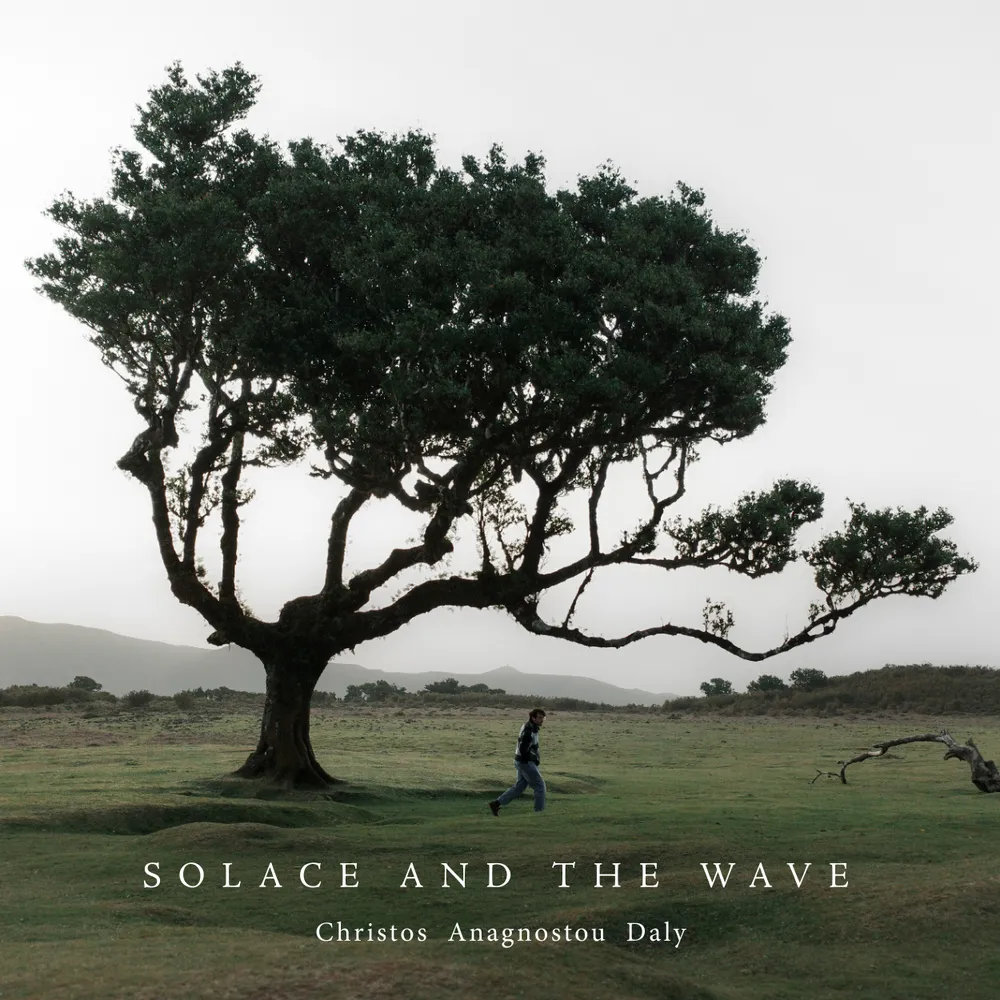
Solace and the Wave by Christos Anagnostou Daly
The album begins with “Hyperborean Suite,” perhaps the clearest introduction to Daly’s musical language. Its mixture of strings, atmospheric electronics and understated rhythmic elements immediately brings certain strands of contemporary neoclassical music to mind, particularly the cinematic minimalism associated with composers such as Max Richter. The resemblance, however, is more about atmosphere and vocabulary than imitation.
Strings remain at the centre of the composition, carrying much of its emotional weight while electronic pads and subtle beats expand the acoustic space around them. The result is sentimental without becoming excessively dramatic. Daly understands that a sustained string texture can often communicate more effectively when it is allowed to remain quiet rather than being pushed toward an inevitable orchestral climax.
“Shapes, Pt. 1” follows and functions almost like an interlude. At just over a minute long, the piece revolves around a repeating piano arpeggio surrounded by atmospheric textures and melodic strings. Its brevity works in its favour: rather than attempting to establish an entirely new musical world, it connects the broader gestures of the opening track with the more expansive title composition that follows.
Waves of Orchestration
“Solace and the Wave,” the title track, forms the emotional centre of the EP. Here, Daly’s orchestration becomes particularly effective because he resists the temptation to use the entire instrumental palette simultaneously. Instruments appear gradually, often almost conversationally, with strings and woodwinds moving in and out of focus.
The composition also develops through changing harmonic colours and modulations rather than through sharp sectional contrasts. There is something appropriately wave-like about its construction: one passage rises from another, changes shape and then recedes while leaving traces of the previous harmony behind. The overall direction remains coherent even as the atmosphere changes.
This approach is especially suitable for cinematic composition. Film music does not necessarily require a memorable theme every few seconds; sometimes its effectiveness lies in allowing harmony, orchestration and texture to reshape the emotional meaning of an image. Daly seems comfortable working within that more patient language.
The next track, “Mensura Silentii,” strips the arrangement back considerably. A short solo-piano piece built around a delicate arpeggiated foundation and understated melodic writing, it provides an important moment of intimacy within the record. Its simplicity also prevents the EP’s electronic and orchestral textures from becoming too uniform. Rather than functioning merely as a miniature, it acts as a moment of silence between larger landscapes.
From Orion to the Final Shapes
For me, “Hymn to Orion” is the strongest track on the EP. It is also one of the shortest, lasting only around a minute and a half. Yet within that limited duration, Daly creates one of the record’s deepest atmospheres.
The opening cello melody emerging against atmospheric electronic pads is immediately captivating. The writing feels spacious and contemplative, while the harmony carries more weight than the track’s modest scale might suggest. There is a sense of looking outward into something considerably larger than the music itself.
This is also where Daly’s interest in mythological and cinematic imagery feels particularly natural. “Hymn to Orion” does not need an elaborate program to establish that sense of scale; the combination of low strings, sustained electronic textures and gradually developing melody is enough. Other material published around the work similarly connects the composition to Orion and to Daly’s interest in mythology, history and the natural world.
The album ends with “Shapes, Pt. 2,” returning to the idea introduced earlier while transforming its character. There is something mysterious and faintly fantastical in the piece, at moments evoking the slightly eccentric orchestral world associated with dark fantasy cinema. I was reminded of the atmosphere of a Tim Burton film; not because the composition directly imitates any particular soundtrack, but because it possesses a similar mixture of mystery, delicacy and playfulness.
The piece closes the EP softly, and importantly, without trying to manufacture a grand finale.
Strength Through Restraint
Perhaps the most interesting quality of the record is what it refuses to do. There is no sudden fortissimo waiting around the corner, no enormous percussion-driven climax designed to prove that the music is cinematic. Daly instead maintains a relatively narrow dynamic and emotional spectrum throughout the six tracks.
That could easily have resulted in monotony, but the changes in instrumentation, harmony and density provide enough internal movement to prevent that. The EP begins softly and essentially keeps the listener inside the same blanket of sound until its final moments.
For someone presenting this work partly as an introduction to a future career in film composition, that restraint is encouraging. Daly appears interested not merely in writing “epic” music, but in shaping atmosphere, pacing and emotional continuity; the qualities that often matter far more in effective screen composition.
Solace and the Wave by Christos Anagnostou Daly ultimately succeeds because it understands its own scale. It is a compact debut built from six carefully connected pieces rather than an attempt to demonstrate every compositional possibility at once. There is already a recognisable sensitivity toward orchestration and sonic space here, particularly when acoustic instruments and atmospheric electronics meet. For listeners drawn to contemporary neoclassical music, cinematic composition and quietly narrative instrumental works, it is a debut worth spending time with.
#ChristosAnagnostouDaly #SolaceAndTheWave #Neoclassical #CinematicMusic #ContemporaryClassical #FilmMusic #FilmComposer #InstrumentalMusic #ModernClassical #OrchestralMusic #PianoMusic #AmbientMusic #CinematicComposer #NewMusic #Tunitemusic