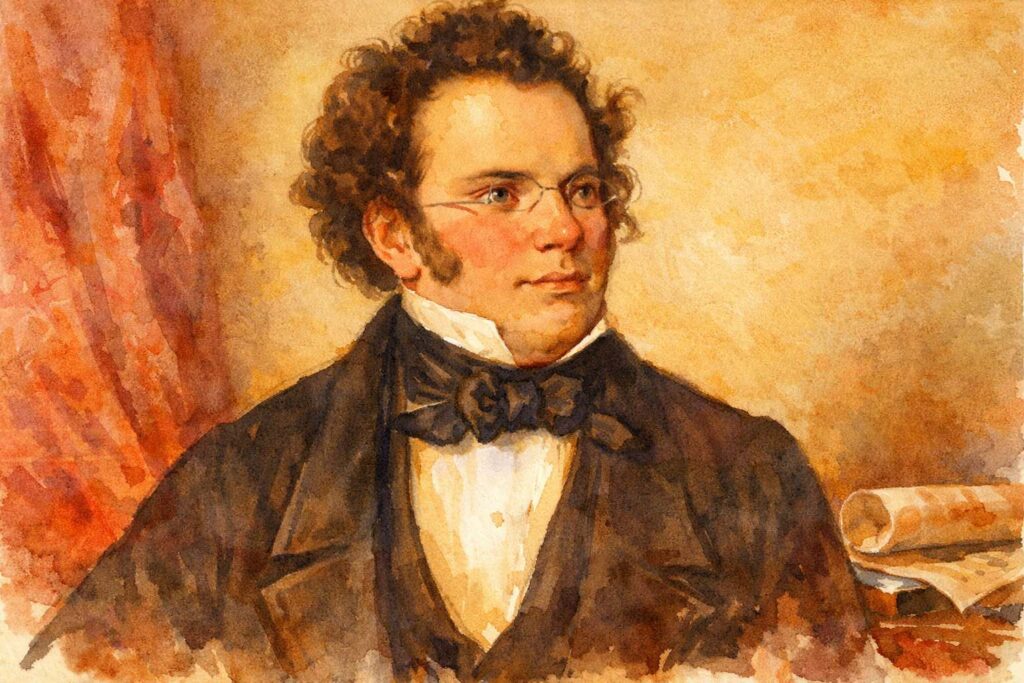
Franz Peter Schubert (31 January 1797 – 19 November 1828) stands among the most important figures in Western music. Though he died tragically young at 31, his output was astonishingly prolific, hundreds of songs, symphonies, chamber works, piano music, and more, and his blend of Classical precision with Romantic expression rewired the emotional potential of music.
Early Life, Education, and First Musical Influences
Schubert was born in Himmelpfortgrund near Vienna, into a musical family. His father was a schoolmaster who encouraged his sons’ musical education, and Schubert learned violin, piano, and organ from a young age under his father and older brother, Ignaz.
In 1808, Schubert won a scholarship to the imperial court chapel choir school (Stadtkonvikt) in Vienna. There he received rigorous training in theory, composition, and performance under teachers including Wenzel Ruzicka and the renowned composer Antonio Salieri.
This early life combined structured Viennese classical practice with exposure to vocal and ensemble music, a synthesis that would shape both his formal craftsmanship and his gift for deeply expressive melodic writing.
Artistic Maturity
Exploring a Vast Musical World
From his teens onward, Schubert wrote in many forms, but it was the Lied (German art song) where he first transformed an existing genre into something transcendent. His setting of Goethe’s “Gretchen am Spinnrade” (1814) is often regarded as a watershed moment in art song, fusing piano and voice into a dramatic, evocative partnership.
His maturity saw an expansion into instrumental forms as well. Works like the Piano Quintet in A Major (Trout Quintet) and the Unfinished Symphony in B minor reveal innovative harmony, unique ensemble color, and emotional depth that push past Classical music norms toward Romantic freedom.
Sentimental Music
In my opinion, Franz Schubert can be seen as one of the earliest major composers to approach music through a deeply sentimental lens. He brought inner emotion, vulnerability, and introspection to the foreground of musical expression. Unlike Beethoven, whose emotional language is often heroic, expressive, and dramatic, Schubert’s music turns inward. His emotional world is quieter, more fragile, and more intimate, rooted in longing, tenderness, and psychological nuance rather than struggle and triumph.
Schubert’s Artistic Importance
Schubert’s importance lies in his role as a musical bridge: he internalized the clarity and balance of Haydn and Mozart, the expressive breadth of Beethoven, and channeled these into new realms of melody, harmony, and poetic storytelling in sound.
He was not immediately celebrated in public concert halls during his lifetime, and many of his works were published only posthumously. Yet the depth of his expressive language, especially in Lieder and late instrumental works, inspired later Romantic composers such as Schumann, Brahms, and beyond, reshaping keynote developments in 19th-century music.
Greatest Works by Franz Schubert
Some of Schubert’s most enduring masterpieces illustrate his inexhaustible creative range:
Lieder and Song Cycles
- Winterreise (Winter Journey), D.911 — A profound psychological journey set to Wilhelm Müller’s poetry; it stands as a pinnacle of Romantic song.
- Die schöne Müllerin — A touching cycle of love, loss, and landscape in song.
Chamber and Instrumental Music
- Trout Quintet in A major, D.667 — Known for its sparkling textures and harmonic exploration.
- String Quintet in C major, D.956 — A late chamber treasure of profound intimacy and strength.
Symphonies and Orchestral Works
- Symphony No. 8 in B minor (“Unfinished”) — Two movements of haunting beauty and structural innovation.
- Symphony No. 9 in C major (“Great”) — A majestic summation of Schubert’s orchestral vision.
Piano Music
- Last Three Piano Sonatas (D.958-960) — Epic, introspective works that push keyboard expression to new heights.
Composition Style and Influence
Schubert’s style is defined by extraordinary melody, harmonic daring, and textual sensitivity. His songs express poetry as though it were a natural extension of musical thought; his chamber and symphonic textures explore modulations and key relationships that prefigure Romantic narrative structure.He expanded formal boundaries gently, allowing music to breathe and flow with emotional logic rather than strict Classical rigidity. Later composers, Schumann, Brahms, Liszt, found in Schubert a model for lyrical instrumental writing and expressive songcraft that shaped their own innovations.
Why Schubert Matters
Franz Schubert matters because he sings with human voice and heart in every measure. He pioneered art song as a serious poetic-musical form and enriched classical genres with an expressive language that feels both intimate and universal. His seamless melding of Classical forms with Romantic expression makes him an indispensable figure in music history: one who broadened the horizon of what music can convey emotionally and structurally.
Final Thoughts
At just 31 years old, Schubert’s catalogue was vast, diverse, and visionary. He died in Vienna in 1828, leaving behind works that (especially once championed by later generations) have become core to the Western repertoire. His music invites listeners into landscapes of tenderness, shadow, joy, and introspection, a journey as resonant now as it was two centuries ago.
Sources & Further Reading
- Encyclopaedia Britannica: Franz Schubert biography
- Encyclopaedia Britannica: Schubert’s maturity and works
- Schubert’s Winterreise article
- Trout Quintet
- Classical overview of late works
- World History Encyclopedia: Schubert songs and legacy
#FranzSchubert #ClassicalMusic #RomanticEra #Lieder #UnfinishedSymphony #TroutQuintet #Winterreise #MusicHistory #ComposerSpotlight #PianoSonatas #ChamberMusic