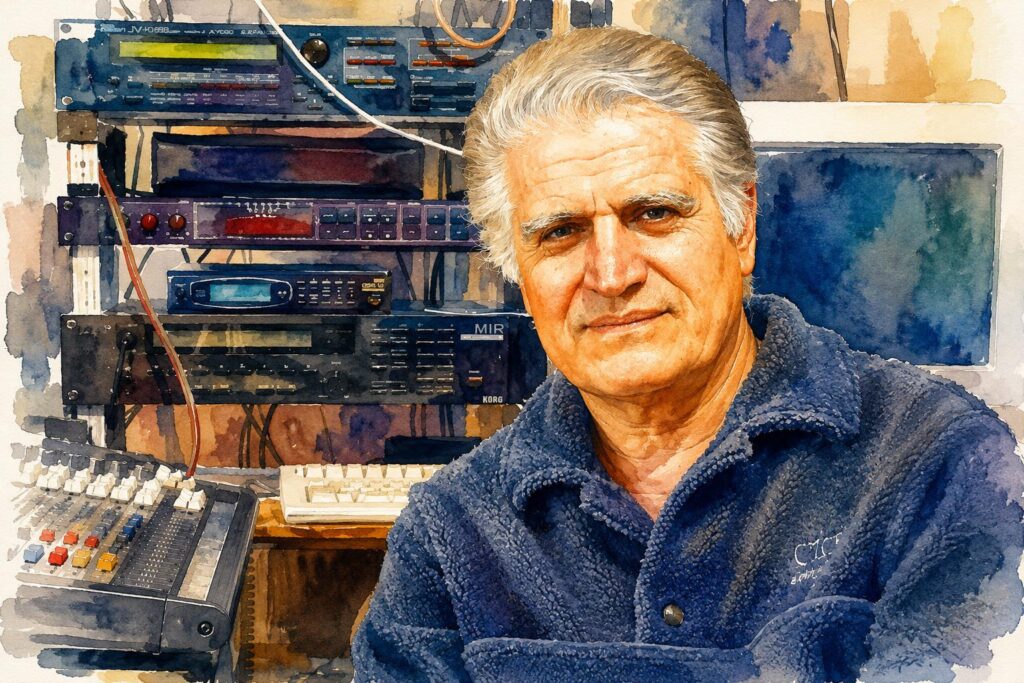
Alireza Mashayekhi (Born on 25th of January 1940) stands as a towering figure in the history of Iranian contemporary music, a composer, conductor, and academic whose bold fusion of Persian tradition with modern Western techniques reshaped the sonic landscape of his homeland. Revered for introducing experimental and electronic music to Iranian ears, his career spans more than half a century and encompasses orchestral, chamber, electroacoustic, and computer-generated works.
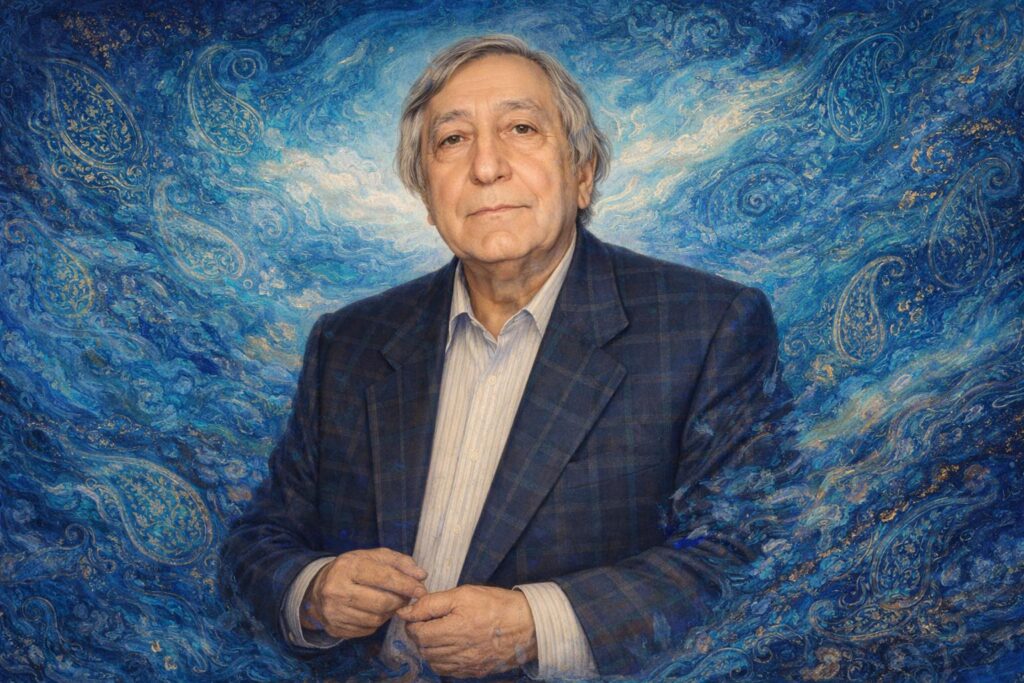
Early Life, Education, and First Musical Influences
Born in Tehran in 1940, Mashayekhi’s earliest education combined the rich heritage of Persian music with formal Western training. Under the guidance of Persian music master Lotfollah Mofakham-Payan, he absorbed the modal and rhythmic intricacies of traditional art music while simultaneously pursuing piano and composition studies with teachers such as Hossein Nasehi and Ophelia Kombajian.
His desire to explore the frontiers of sound led him to Europe, where he studied composition with influential figures like Hanns Jelinek and Karl Schiske at the University of Music and Performing Arts in Vienna. A subsequent period at the Institute of Sonology in Utrecht under Gottfried Michael Koenig deepened his engagement with electronic and computer music. It was here that Mashayekhi encountered the avant-garde movements reshaping post-war musical thought, serialism, electronic synthesis, and algorithmic composition, which would become integral to his creative voice.
Artistic Maturity: Key Works and Institutional Contributions
Mashayekhi’s maturity as an artist is defined as much by his compositions as by his role in cultivating a broader musical culture in Iran. In 1993, he co-founded the Tehran Contemporary Music Group, followed by the Iranian Orchestra for New Music in 1995, ensembles dedicated to performing avant-garde repertoire and championing new works by Iranian composers.
His compositions traverse a remarkable range. From orchestral works that draw on Persian rhythmic cycles and folk modes to starkly atonal pieces and electroacoustic creations incorporating live electronics, Mashayekhi never confined himself to a single stylistic lane. Works such as Symphony No. 4 (Zagros), Avec Chopin, and the piano-centric Kristall series reflect a fearless engagement with form, timbre, and cultural identity.
Among his notable projects is Sheherazade, a multi-section work combining Western piano writing with Persian narrative elements, premiered in Tehran in 1998. This piece exemplifies his ability to weave disparate traditions into a cohesive musical experience.
Mashayekhi also made substantial contributions to recording and dissemination: anthologies like Persian Electronic Music: Yesterday and Today (1966–2006) document his role in the evolution of Iranian electronic music, while collaborative releases such as Ornamental, produced with electronic artist Ata Ebtekar, highlight the adaptability of his compositions across genres.
Composition Style and Influence
At the heart of Mashayekhi’s work is a philosophy he terms “Meta-X”—a compositional practice embracing sonic multiplicity. Rather than forcing a synthesis, Meta-X acknowledges contradiction: tonal vs. atonal, Persian vs. Western, improvised vs. pre-defined—all coexist as integral facets of a musical whole. This dialectical approach allows his music to defy easy categorization while aligning deeply with the complexities of contemporary cultural identity.
His music reflects influences as wide-ranging as John Cage’s exploration of sound and silence, Edgard Varèse’s spatialized textures, Henry Cowell’s innovative techniques, and Karlheinz Stockhausen’s electronic labyrinths. Yet these resonances are refracted through an Iranian sensibility, modal inflections, rhythmic layers, and an intuitive sense of narrative and texture.
Crucially, Mashayekhi’s legacy isn’t limited to his own works: the ensembles he founded, the students he taught at the University of Tehran, and the generations of composers inspired by his example are all part of a living lineage. Through his leadership, the Iranian contemporary music scene gained institutional platforms and a vocabulary for experimental practice that remain vital today.
Why Alireza Mashayekhi Matters
Alireza Mashayekhi’s importance lies in his role as a cultural catalyst. At a time when Iranian music was largely anchored in classical and folk traditions, he opened horizons that fused global modernism with indigenous artistic identity. His work challenged conventions, expanded the technical and expressive palette available to Iranian composers, and asserted that innovation could emerge from local roots as much as from international influence.
By integrating Persian instruments and modes with avant-garde structures and electronic media, Mashayekhi helped position Iranian music within a truly global contemporary discourse. His compositions and initiatives continue to influence composers seeking to negotiate their own cultural legacies in an interconnected artistic world.
Final Thoughts
In the trajectory of 20th- and 21st-century music, Mashayekhi occupies a unique and visionary place. Not merely an innovator for innovation’s sake, he forged bridges—between traditions, between sound worlds, and between generations. His life’s work poses a profound question: how can one remain rooted in heritage while boldly exploring uncharted artistic territories? The answer, in Mashayekhi’s music, is that authenticity and experimentation are not opposites but partners in a dynamic creative life.
Alireza Mashayekhi’s legacy is thus not just in notes on a page, but in the fertile musical ecosystems he helped grow and in the continuing dialogues his music inspires across cultures and styles.
Sources:
- Wikipedia, “Alireza Mashayekhi”
- Kimia Hesabi Cultural Foundation, “Alireza Mashayekhi”
- Recent Music, Alireza Mashayekhi Artist Profile
- Issue Project Room, “Sounds of the Avant-Garde: Alireza Mashayekhi, John Cage, Henry Cowell…”
AlirezaMashayekhi #IranianComposer #ContemporaryMusic #AvantGardeMusic #ElectronicMusic #PersianMusic #ModernClassical #ExperimentalMusic #IranianContemporaryMusic #MetaX #ElectroacousticMusic #NewMusic #20thCenturyMusic #21stCenturyMusic #MusicPhilosophy #GlobalModernism