Archaeologists in west Norfolk have made a remarkable discovery that reshapes our understanding of prehistoric soundscapes and musical expression. During a routine excavation ahead of a housing project, researchers uncovered a near-complete Iron Age battle trumpet, known as a carnyx, one of the rarest ancient musical instruments ever found in Britain.
Source: Classicfm
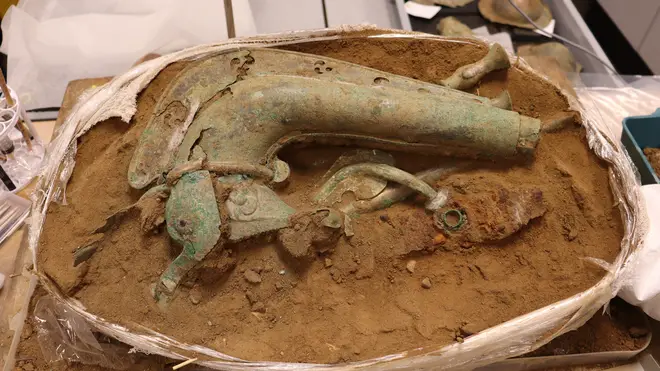
The carnyx, a long bronze wind instrument crowned with an animal-shaped head, was once used by Celtic warriors both to rally troops and to intimidate opponents in battle. Its unique design, meant to be held vertically and sounded above the chaos of combat, made a powerful acoustic statement across the battlefield.
This Norfolk carnyx is exceptional not only because of its age — roughly 2,000 years old — but also for how much of it has survived. It is one of only three carnyces ever discovered in Britain and among the most complete examples in Europe, offering an extraordinary look into the musical and cultural practices of Iron Age communities.
The instrument was found as part of a larger hoard that also includes a bronze boar’s-head standard and several shield bosses, suggesting a deeply symbolic and likely martial context for the deposition of these objects.
Historic England, together with Pre-Construct Archaeology, Norfolk Museums Service, and the National Museum of Scotland, is now leading conservation and research efforts. Specialists believe the carnyx and its accompanying artefacts will illuminate not just Iron Age warfare, but also the role of sound and performance in prehistoric social life.
This discovery is a powerful reminder that music, even in its most ancient forms, was deeply woven into human experience. For composers, performers, and listeners today, the carnyx stands as a bridge to the primal origins of sound as ritual, communication, and collective identity.
#AncientMusic #IronAge #Carnyx #AncientInstruments #MusicHistory #Archaeology #SoundOfThePast #PrehistoricMusic #Norfolk #England #MusicalHeritage #AncientSound #HistoryOfMusic #InstrumentDiscovery #CulturalHistory